


You have the plan. The time is there too. And still it does not get done. You have already been through the plan and the week, and neither is the problem. So try a different question, because identity limits performance in a way scheduling does not reach. What you quietly believe about the kind of person you are sets a ceiling on what you will attempt, and from the inside that ceiling is almost invisible.
That is a claim about how things work rather than a measured finding. The evidence below is more mixed than the idea's popularity suggests.
This post sets out what builds the ceiling, what the research actually shows, and what to do about it.
Why Identity Limits Performance Before Effort Does
Identity here means the sentence you would finish honestly, not the one you would say out loud. "I am the sort of person who..." Many people can finish it in a second, and find they would rather not have.
Those sentences do work. Someone holding "I always lose momentum" has an explanation ready before the difficulty arrives. An explanation held in advance quietly removes the need to test it. Someone holding "I am not senior enough for that room" behaves accordingly in the room.
The reason identity limits performance ahead of effort is timing. Effort is what you bring to something you have already decided to attempt. Identity shapes what you attempt at all.
What Identity Means Here
A long research tradition sits behind the idea that people act to keep their self-view intact, even when that view is unflattering.
Swann and colleagues found that people holding firm negative self-views sought out feedback that confirmed those views (Swann, Pelham and Krull, 1989). Treat that as the origin of an idea rather than settled proof. The three studies were small, and ran on undergraduates in a laboratory: 42 participants, then 48 pairs, then 26.
The pattern is recognisable outside the laboratory, though that extension is an inference rather than something these studies tested. We notice evidence that fits the story we hold, and explain away the rest. Praise slides off. A setback confirms.
How Identity Limits Performance in an Ordinary Week
It is rarely dramatic. It shows up as small decisions that each look reasonable.
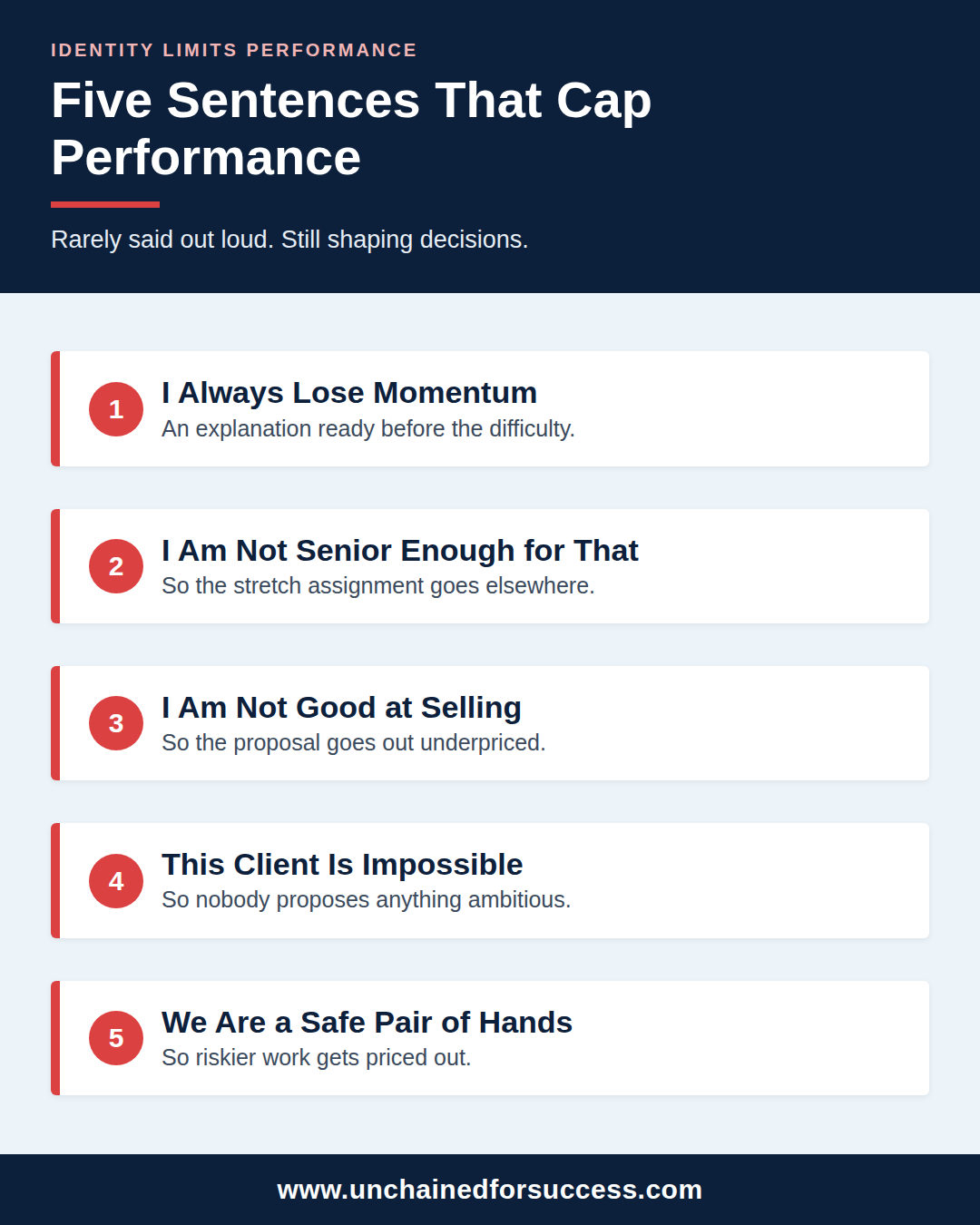
"I am not senior enough for that" sends the stretch assignment to someone else, and you were busy that week anyway. Behind a proposal that goes out at the lower price sits "I am not good at selling", because the higher price felt uncomfortable. Training slips once, and once is fine, which is what "I always lose momentum" sounds like on the day.
None of those is a failure of effort. Each is a small adjustment that keeps behaviour in line with the sentence. That is how identity limits performance in practice, one reasonable choice at a time.
Over a year those adjustments add up to a result. The result then looks like proof of the sentence. That circle is why identity limits performance more stubbornly than a poor plan does. A poor plan fails in plain sight. An identity ceiling does not fail visibly at all. The year simply comes out flatter than it should have.
The Most Tested Version of This Idea
Here is where most articles on this subject stop being useful, so it is worth going slowly.
Growth mindset is the best-known version of "change your beliefs, change your results". Researchers have tested it more thoroughly than most self-improvement claims ever get tested, and the results have not been kind to the popular reading.
One review pooled 63 studies covering 97,672 students (Macnamara and Burgoyne, 2023). The average effect on results was close to zero. Studies with good news reach print more easily. Correct for that, and the average is no longer distinguishable from zero. Among the six highest-quality studies it was smaller again, and the range around it included no effect at all.
So a short course that only changes what people believe about themselves does very little about the way identity limits performance. That sits awkwardly in a post about identity. Saying it plainly seems better than working around it.
Why Identity Limits Performance Even After a Pep Talk
Belief change alone underdelivers because a belief is not the whole mechanism. It has to survive contact with what happens next.
Tell someone they can improve. Send them back into the same week, with the same diary, the same colleagues and no new evidence at all. The sentence returns to whatever it was, and identity limits performance exactly as before.
This may be why affirmations feel hollow to many of the people who try them. Not because the sentiment is wrong, but because a claim with nothing behind it is just a claim, and you know it.
Where Identity Limits Performance and Where It Does Not
The same field produced the best-designed single study, and it points somewhere specific.
One national trial in the United States covered 12,490 ninth-grade students across 65 schools (Yeager and colleagues, 2019). The team registered its analysis plan before seeing results, one independent organisation collected the data and a second processed it, and a blinded robustness check ran on top of that.
For the students who had been doing badly, it found a real effect, and a small one. They gained about a tenth of a point on the four-point grade average used in American schools.
Two details matter more than the headline. The gain showed up among students who were already struggling, not across the board. And the effect was larger in schools where the norm among peers was to take on challenge, while it was weaker in the highest-achieving schools.
The mechanism this points to is that belief reaches results through what you then do, and only where the setting allows it. That makes evidence and setting the sensible places to push. No study here tested pushing them directly, so treat that as the reasonable next step rather than a proven one.
What Changes Identity Instead
Two levers, and the second is the one most advice skips.
Evidence You Produce Yourself
The first lever is a completed action the old sentence cannot explain.
It does not need to be big, which is the good news about the way identity limits performance. A heroic month is unlikely to defeat "I always lose momentum". A small thing done on a Tuesday when you did not feel like it has a better chance, and then the Tuesday after that. Each repetition is evidence with your own name on it.
Pick something small, fully within your control, with a fixed day and time. Keep a record, because the sentence will try to forget. This is the slow way the ceiling moves.
A Setting That Allows the New Behaviour
A belief that nothing around you supports is hard to hold.
If your team treats a missed deadline as normal, your private decision to be reliable has weather to fight. If nobody you work with charges what you want to charge, the higher price stays uncomfortable.
The school trial suggests that what the group treats as standard is doing work private resolve is not. This is the second place identity limits performance, and it sits outside you.
Identity Limits Performance in Teams and Organisations
The same pattern runs at scale, and it is easier to spot in other people. Both examples below are composites rather than clients, with the details invented to make the pattern visible.
A Project Team That Believed It Could Not Recover
A programme team, two quarters behind, shares one sentence: this client is impossible.
That sentence does not stop anyone working. It changes the character of the work. Meetings turn defensive. People raise issues once they are unavoidable rather than while they are still cheap. Nobody proposes anything ambitious, because ambition would have to survive a meeting.
What shifts that is not a speech. It is one recovery milestone, chosen because the team can reach it in three weeks without the client's help, and then reached.
An Organisation That Called Itself a Safe Pair of Hands
An organisation says it warmly and often: we are a safe pair of hands, not a market leader. The phrase turns up in bid documents and in corridors.
It also shapes decisions. Riskier work gets priced out. Interviewers judge new hires on how well they fit in. The phrase is not a description at all. A filter works this way precisely because nobody argues with it.
Nothing in a values statement changes a filter. What changes it is a single bid the phrase would have ruled out, submitted and then discussed openly whichever way the client decides, and a hiring panel asked to score for difference rather than fit.
Separating Who You Are From What Just Happened
One specific error makes all of this worse, and it happens the moment a result comes in short.
The result tells you about a system: a plan, some assumptions, the people on it, a guess at how much the week could hold. It is also not the direction you chose. It is one attempt at moving along it. Read it instead as news about the person, and the thinking stops.
The Unchained Goals Framework treats that as a structural mistake rather than a confidence problem. One correction is to anchor identity to the problem you have taken responsibility for and the long-term position you intend to build within it. The framework calls those Purpose and Vision. Any particular outcome is an instrument for moving in that direction, not a verdict on who you are.
This is not a way of dodging accountability, and it is where identity limits performance most: in the gap between a result and a verdict about you. It is what makes accountability usable, because "the system, as configured, did not hold under that load" is a sentence you can act on. "I am not good at this" is not.
Beliefs behave like structure rather than mood, which is why the fix is structural too. Check which of your assumptions rest on evidence and which ones you simply picked up, then go and make some evidence. Hidden Beliefs That Undermine Your Goals works through that audit.
Frequently Asked Questions About How Identity Limits Performance
If growth mindset barely works, why does any of this matter?
The finding is narrower than "belief does not matter". The national trial found that a short intervention produced a small benefit for students who were already struggling, and worked better where peers accepted challenge. What follows in this post goes one step further than the trial did: pair belief work with repeated action, in a setting that supports the new behaviour.
How long does it take to change an identity statement?
No reliable number exists, and anyone offering one is guessing. What holds is the mechanism: evidence accumulates, so the timescale follows how often you produce it.
Can I do this without changing my environment?
It is harder. The strongest study found a larger effect in schools where the norm among peers was to take on challenge. If you cannot change the whole setting, change part of it, including who you measure yourself against.
Where Identity Limits Performance, Change the Evidence and the Setting
The popular advice is to think differently about yourself. On its own, the evidence says that does almost nothing about the way identity limits performance.
The practical method used here is duller, and it comes down to four moves. Three of them build the evidence. The fourth changes the setting. Treat it as the approach the framework draws from this evidence rather than as a method these studies tested.
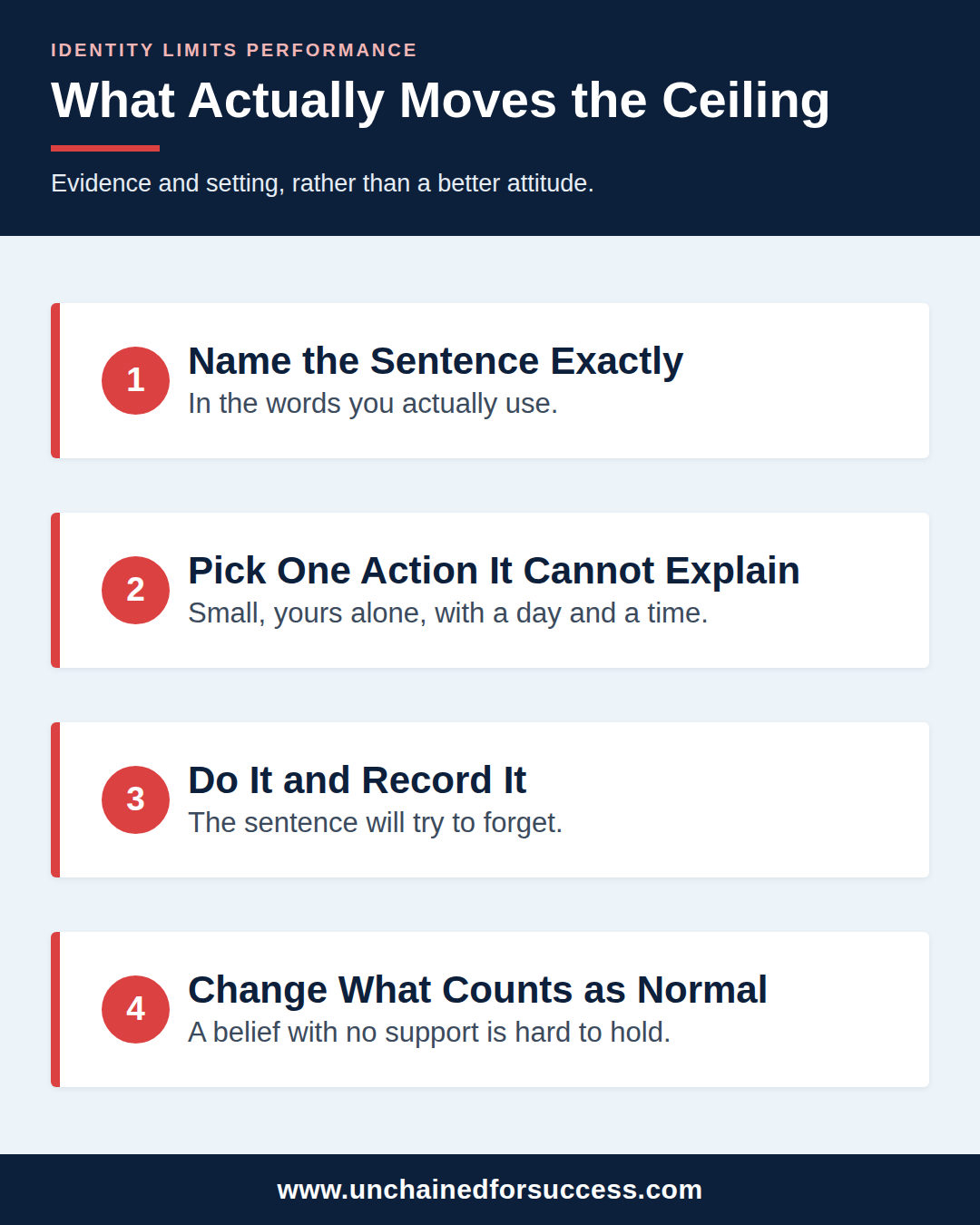
Name the sentence precisely, in the words you actually use. This is harder than it sounds, because the sentence rarely announces itself, and it is usually easier to find in your decisions than in your thoughts.
Then choose one small action it cannot account for, fully within your control, with a day and a time attached. Do it, and record it.
Finally, look at what the people around you treat as normal, because in the strongest study that was where the difference showed up.
Identity limits performance for as long as the evidence keeps agreeing with it, and it can hold on well past the first contradiction. That is a slower answer than a change of attitude. It is also the one the evidence points towards.
Sources
• Macnamara, B. N. and Burgoyne, A. P. (2023). Do growth mindset interventions impact students' academic achievement? A systematic review and meta-analysis with recommendations for best practices. Psychological Bulletin, 149(3 to 4), 133 to 173. https://doi.org/10.1037/bul0000352
• Yeager, D. S. and colleagues (2019). A national experiment reveals where a growth mindset improves achievement. Nature, 573(7774), 364 to 369. https://doi.org/10.1038/s41586-019-1466-y
• Swann, W. B., Jr., Pelham, B. W. and Krull, D. S. (1989). Agreeable fancy or disagreeable truth? Reconciling self-enhancement and self-verification. Journal of Personality and Social Psychology, 57(5), 782 to 791. https://doi.org/10.1037/0022-3514.57.5.782
Continue Your Journey
Explore more resources from the Unchained Goals Framework: