

A physiotherapist was due to open a practice with a colleague in March. They had chosen the rooms and agreed the terms of a lease that both of them had to sign, and she had handed in her notice. In January the colleague withdrew, and a year of work went with him. Recovering momentum from that position is what this post is about.
The landlord would not hold the rooms for one signature, they lost the holding deposit, and her job was due to end in February. A year's plan was back at the start.
The first thing to know is where momentum comes from. You do not need your confidence back first. Restart the smallest piece of the work you control, keep a record of what it produces, and your confidence has something to follow. Waiting until you feel ready can delay the work that rebuilds the feeling.
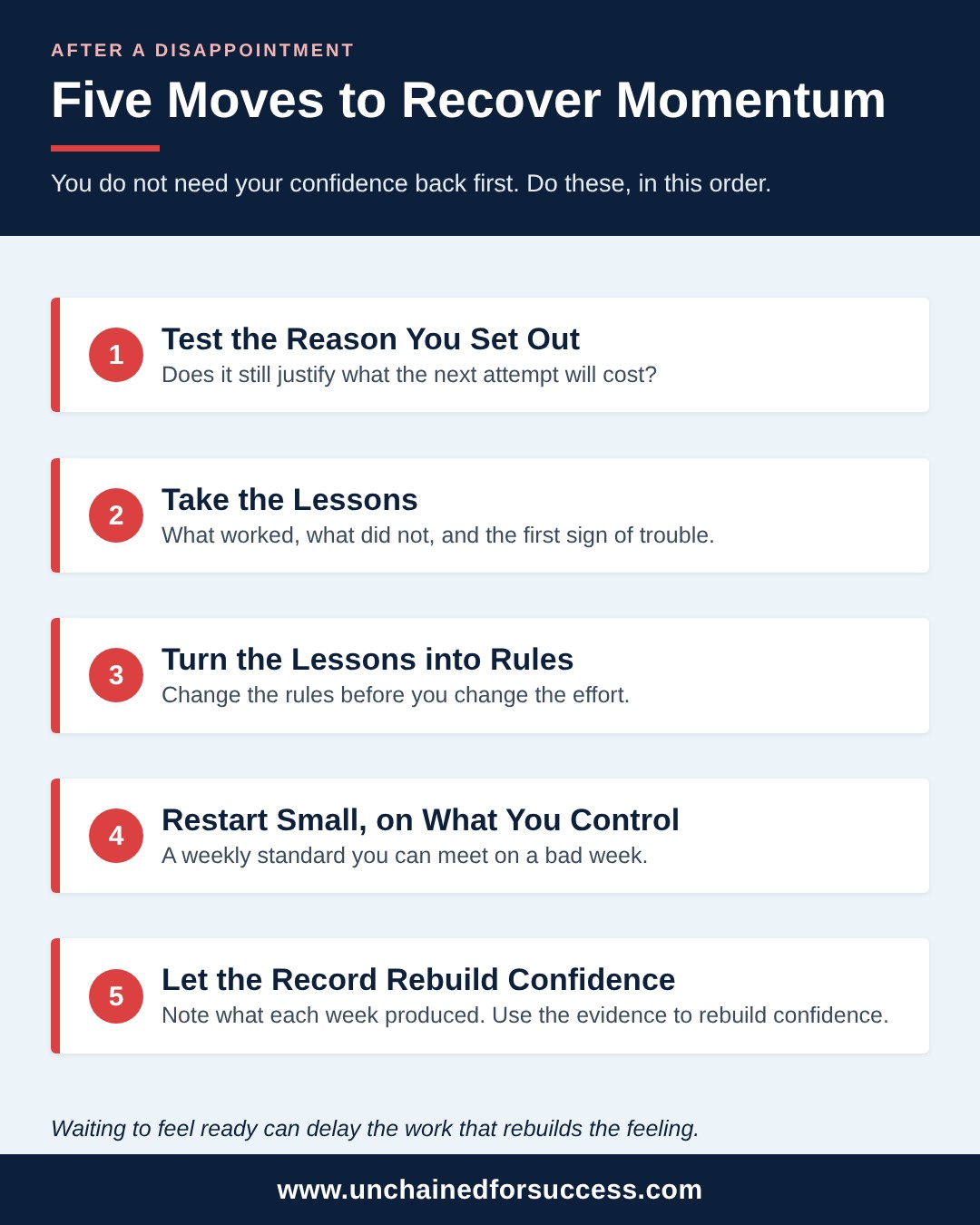
She is an illustration rather than a client, but you may know the position in one of its forms: a plan that fell through, a decision that went against you, an injury that stopped you. Use these five moves, in this order, to organise your restart. I will take you through them with her case, and then show the same moves in a restart of my own.
Momentum is not a feeling that arrives. It is a record of work that moves you.
Move 1: Decide Whether the Reason Still Holds
Deal first with whatever cannot wait: income, a notice period, a promise already made. She asked her employer to extend her contract by two months, three days a week, and got it.
Then go back to why you set out. Not the goal itself, but the reason the cost was worth paying. A disappointment raises the cost, and determination will not bring back the money and time already spent. So test the reason against what the next attempt will now cost. Ask four questions:
• Does the reason still justify what this will now cost?
• Has anything changed that makes it weaker, or stronger?
• Is this still a problem I want to be responsible for?
• Am I willing to carry the new cost?
Her reason was hers rather than her partner's: patients get 45 minutes with her instead of 20, in a practice run her way. The cost had risen, with less money in the bank and nobody to share the rent. She decided the reason still held. Then she decided the harder thing, that she was willing to carry the higher cost.
If the reason does not hold, stopping is a decision and not a surrender. Put the effort elsewhere within the same purpose. If you cannot decide yet, give the question a date, because a reason that is neither confirmed nor dropped leaves you working without one.
Move 2: Take the Lessons Before the Next Step
Before you commit to the next attempt, take the lessons from the first. Write down what worked, what did not, and the first sign of trouble. Last week's six steps do this in detail, and a single page is enough. Hers had four lines on it.
• Still promising: the service she planned to offer, and what clinic owners had said about it.
• Still untested: whether enough patients would pay her price.
• What did not work: agreeing lease terms, and giving notice, before the partnership was secure.
• The first sign: her colleague's doubts had been audible since October. She had talked him out of them twice instead of listening.
Move 3: Turn the Lessons into Rules for the Next Attempt
The tempting restart is more of the same, harder. Let the lessons change the rules first. If you had rules for the first attempt, improve them. If you had none, write them now. Before she made a single approach, she wrote four down.
• Any future partner must bring capital of their own, a written commitment, and an agreed consequence for walking away. Doubts spoken aloud are information, not something to argue away.
• She will only consider premises whose full commitment she could carry alone if a partner fell away.
• In a first conversation she will ask what the rooms cost, which days are free, what patients there pay, and whether the clinic takes a share of her fees. Then she knows within half an hour whether to go further.
• She will offer what an existing clinic actually wants: a specialism they lack, on days their rooms stand empty.
Set the rules before you restart, and review them when new evidence shows that one needs to change.
Move 4: Restart Small, on What You Control, and Keep the Record
Now restart the work. The only condition is that it must be yours to do. Not a result that waits on someone else, such as a signed lease or a reply, but a behaviour you can carry out this week.
She set a weekly standard: three prepared approaches to clinic owners about renting rooms by the day, each followed up at the next session. Three, not ten. A standard you can meet while your confidence is low is worth more to momentum than one you can meet only when it is high.
She prepared and sent the approaches, and followed up earlier ones, in half-hour sessions at 7.30 am on Monday, Wednesday and Friday, before work, from the first Monday in February. Each time, she recorded what she did and what it produced or taught her.
• Week one: three approaches and one reply, but no conversation. She noted what the reply said about price and changed her next approaches.
• Week two: three more approaches, two conversations and one clinic that was interested.
• Week three: that clinic offered her two rooms on Tuesdays and Thursdays from March.
It was not the practice she had planned, but it was a start: her own patients, run her way. Two days would not pay for a full practice, so she added a fourth session and raised the standard to five approaches a week, looking for rooms on the other three days.
Choose a weekly standard you can meet on a bad week. Then meet it, and write down what it produced.
Move 5: Let the Record Rebuild Confidence and Momentum
Confidence is a belief about what you can do, and beliefs change most reliably when the evidence changes. That is why the record matters more than the mood, and why it has to show what the work produced, not only that it happened.
So every Sunday, count the week against the standard and read what it produced: a reply, a lead, a lesson, a next step. If weeks of approaches produce none of these, review who you are approaching and what you are saying before you send more.
Choose in advance what will make you look harder. For example, two weeks running below the standard could prompt three questions, in this order:
• Is something stopping the sessions?
• Are the sessions producing the approaches?
• Only then, is the standard too high for now?
Either way, look at the behaviour before you redefine the goal or add hours.
Her momentum came back in the fourth week. Not because the offer arrived, but because by then she had three full weeks in the record and knew she would do the fourth. That is recovering momentum, and the record is how you see it happening.
A Restart of My Own
The physiotherapist is an illustration. This one is not. My organisation has been developing a large programme, and our search for investors runs from a first approach, through the detailed information and a term sheet, to due diligence on both sides and then contracts.
We found a group who said they could finance the whole of it. Our due diligence raised a number of items. They gave reasons for each, and we accepted them. Then we signed the contracts. Once we had signed, the funds were due, and the excuses piled up. We ended the relationship and were back at the start, having put in a great deal of money and time. It cost us heavily, and our momentum went with it.
Before restarting the search we went back to the reason we had taken this path, our why and our vision. The reason held, and the lessons changed what we did next.
Our first sign had been in the due diligence: one item that they explained away. Had we pressed for the detail instead of accepting the reason, we might have found the problem before we signed. So now no reason stands in for evidence: every item is met in full before any contract. We also tightened who we would contract with, which organisations we approach, and what we decide at a first meeting.
Then we started again, through the same steps, against a milestone agreed with others. The work we control each week is the first of those steps, and we note what each produced. Since the restart we have approached close to fifteen investors and fund-structuring organisations, taken three forward, and are progressing with one.
The outcome is open. What has come back is the momentum: each week there is work we can do, we do it, and we know where we stand.
Recovering Momentum Starts Before You Feel Ready
Nothing in the five moves waits for confidence. So if you are at the start again, do these things this week.
• Write the reason in one sentence. Decide whether it still holds, and whether you will carry the new cost.
• Write down one lesson that changes the next attempt.
• Turn it into one rule for the next attempt.
• Schedule one piece of work that is yours to do, and do it.
• Record what it produced, and choose the date you will look again.
What is one piece of work you will restart this week? Share it in the comments.
Further Reading on Recovering Momentum
These moves draw on the Unchained Goals Framework, which treats recovery as rebuilding rather than a change of mood, and the Goals Readiness Score is 18 questions on how you have set your own goals up. Three related posts: Why Failure Isn't the Real Problem, Handling Setbacks Without Losing Direction and Why Ownership Changes Everything.
Does Research Support Recovering Momentum This Way?
Two pieces of research sit behind this post. Neither tests the moves themselves.
Small progress counts, and setbacks weigh more. Teresa Amabile of Harvard Business School and Steven Kramer collected some 12,000 end-of-day diary entries from 238 people in seven companies. The most common feature of the best days was progress in work that mattered to the person, including small wins. On the worst days it was a setback, and setbacks weighed more.
The lesson I draw: a small step that moves the work does more than it looks, and a quiet week can feel discouraging, which is a reason to keep the standard small.
Confidence follows what you do. Albert Bandura's 1977 theory of self-efficacy, in Psychological Review, names four sources of a person's belief in their own ability: their own successful performance, watching others succeed, persuasion by others, and their physiological state. It calls the first especially influential.
The lesson I draw: work that produced something is the evidence that changes confidence, and early failures can lower it, which is one more reason to make the first standard meetable.
Sources
1. Amabile, T. M. and Kramer, S. J. (2011). "The Power of Small Wins." Harvard Business Review, 89(5), pp. 70 to 80. Available at: https://hbr.org/2011/05/the-power-of-small-wins. The figures above are given in a Harvard Business School article drawn from an interview with Teresa Amabile, on HBS Working Knowledge, which is the open record used here.
2. Bandura, A. (1977). "Self-efficacy: Toward a unifying theory of behavioral change." Psychological Review, 84(2), pp. 191 to 215. Available at: https://doi.org/10.1037/0033-295X.84.2.191.
Continue Your Journey
Explore more resources from the Unchained Goals Framework: