
You set strong goals in January. The plan was sound, the targets were fair, and your effort was real. Now it is July, and something feels heavier. The work has not changed, yet you tire sooner and recover slower. This is the point where a hard lesson arrives. You cannot sustain high performance on ambition alone. You sustain it on health.
Health is not a soft topic that sits beside your goals. It is the physical condition that keeps you able to do the work. When energy holds, execution holds. When health erodes, even a well-built goal begins to stall. This post shows how health protects the part of your goal system that actually produces movement, and how to keep it strong for the full year rather than the first quarter.
Why You Cannot Sustain High Performance Without Health
Ambition is easy to summon for a week. It is far harder to hold for twelve months. The gap between a fast start and a finished year need not be a gap in desire. It can be a gap in energy.
This is the deeper layer beneath energy management. The earlier post, Energy Management Beats Time Management Every Time, showed how energy protects your daily capacity. Health is what makes that capacity available in the first place. Energy is the signal. Health is the source.
Tony Schwartz and Catherine McCarthy made this case in the Harvard Business Review. Time, they argue, is a finite resource; energy is different, because you can expand and renew it. They describe four sources of it, the body, emotions, mind and spirit, and they warn that the usual response to rising demands, working longer hours, leads to burnout. Their point is structural, not motivational. Output depends on the state of the person producing it.
The Cost of Ignoring Health Shows First in the Mind
Lim and Dinges reviewed 70 articles on total sleep deprivation lasting less than 48 hours and reported the results in Psychological Bulletin. Attention showed the largest impairment, the lapses in vigilance that make people miss things. Working memory was also affected.
That is a review of going without sleep altogether, not of every tired week, so read it as a clear pattern at the extreme rather than a rule for ordinary fatigue. Still, the direction is plain. People who are short of sleep notice less and hold less in mind. That is why health is the quiet foundation under any attempt to sustain high performance.
Health Fuels the Movement That Lets You Sustain High Performance
Here is the idea in one line. Health does not set your direction, but it powers everything that moves you along it.
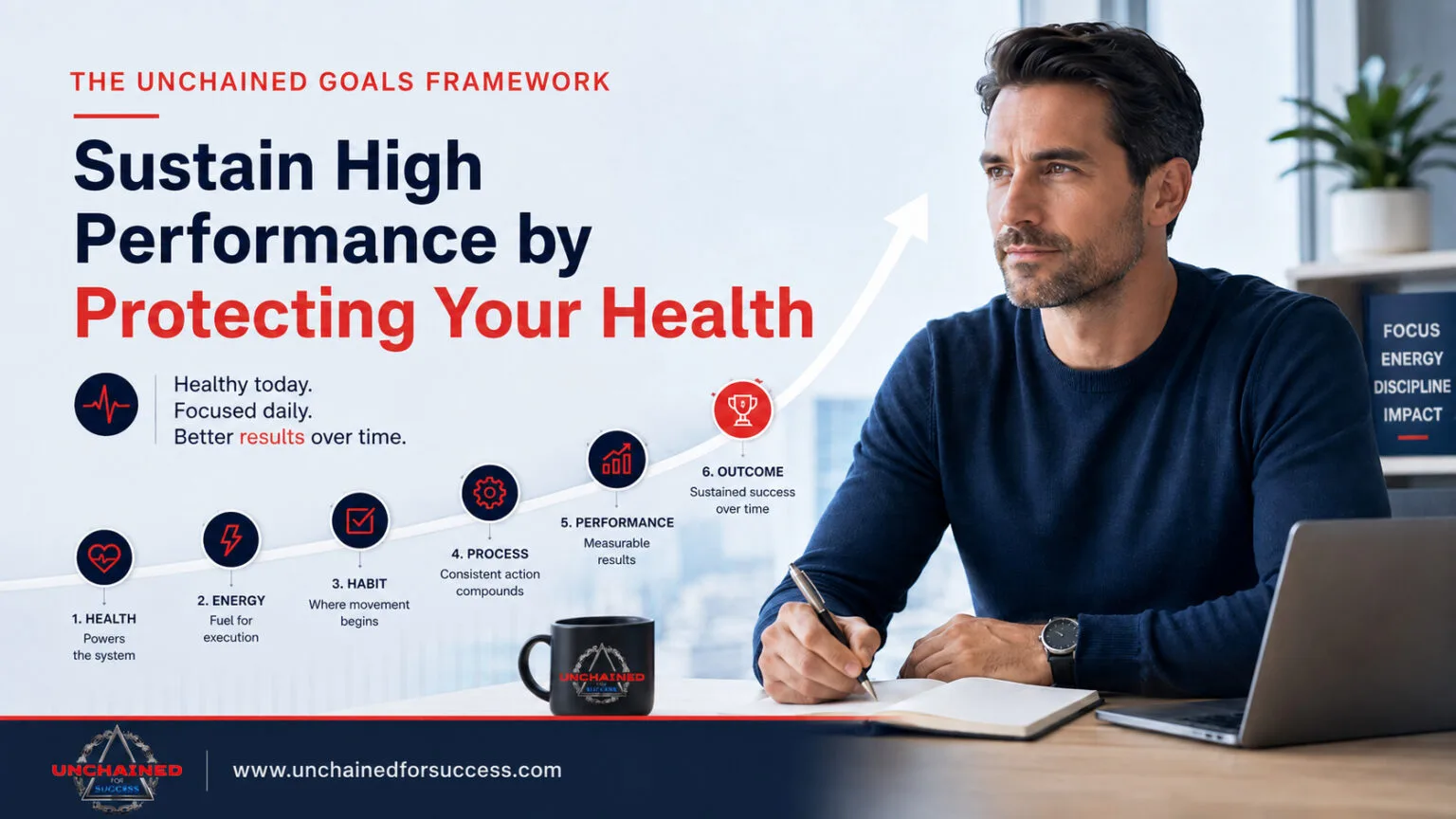
A goal moves through action. Action depends on consistency. Consistency depends on energy. Energy depends on health. Break any link low in that chain, and the links above it weaken too. A brilliant Plan cannot rescue a depleted body, because the Plan does not act. You do.
This is why health belongs in a goal system as a condition, not as a slogan. It will not choose your goal or justify its cost. What it will do is protect your capacity to keep acting when the year gets long and the early excitement fades. Treat health as the fuel supply for a system that already knows where it is going.
Where Health Sits When You Sustain High Performance
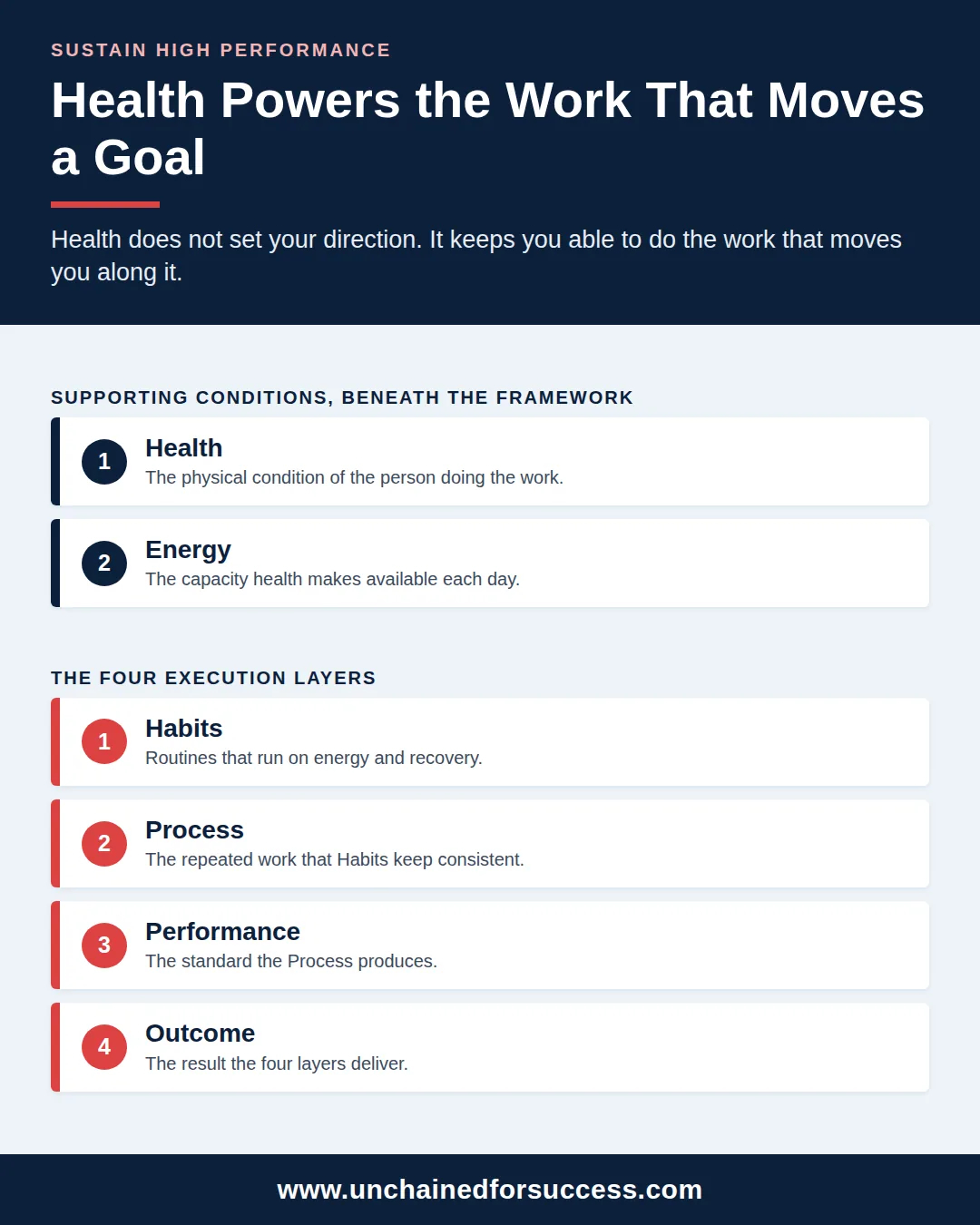
The Unchained Goals Framework has nine components: Purpose, Vision, Goals, Why, Ownership, Beliefs, Plan, Habits and the Control System. Health is not one of them, and it should never count as one. It sits underneath the whole structure as the physical condition that keeps you able to operate it.
To see where health does its work, look at how the framework runs once you have built it. The Outcome Goal (the result), the Performance Goal (the standard it needs), the Process Goal (the behaviours that produce that standard) and Habits (those behaviours made routine) form the Directional Execution Spine, the only part of the system that produces movement.
To Sustain High Performance, Protect the Work That Moves
All four layers depend on a person with the energy to run them. Habits are the repeated behaviours that Habit Conversion has made routine, and repeated behaviours run on energy. Poor health or inadequate recovery can reduce consistency, judgement and work quality, weakening progress towards the goal. You may keep the routine and still produce worse work inside it.
The Plan is where health first appears in the design, because a credible Plan rests on sustainable capacity, the pace you can hold without breaking down, rather than the peak you can reach for a fortnight.
Measure Energy If You Want to Sustain High Performance
The Control System is the framework's governance component. It compares your agreed Performance measures with their operating range and keeps enough record of your Process behaviours and Habits so that diagnosis can begin reliably when a result falls below range and meets its trigger. It does not watch health on its own. To govern energy, you have to define it as a measure, with a range and a trigger, next to the measures of progress.
Do not wait for burnout to notice a problem. Put one energy measure on the scorecard, so that you catch a decline early and correct it before the work suffers. That is how you protect capacity over a year.
This links directly to Capacity Before Goals, because ambition alone does not create capacity. The condition of the system protects it. If you are already stretched, Outgrown Your Capacity? 7 Signs to Watch For helps you spot the warning signs before the work begins to suffer.
Three Examples of How to Sustain High Performance
Consider how this plays out across three settings. The people in them are illustrations, not clients.
An Individual Who Could Not Sustain High Performance
A consultant sets an Outcome Goal to finish the first draft of a book by year-end. The Plan is sound, and the first two months go well. Then late nights erode her sleep. She keeps sitting down to write most mornings, but the pages come slowly and need heavy rework, and output falls.
The goal did not fail at the level of direction. It failed because poor recovery cut the quality and consistency of the work. Protecting sleep would have protected the work, and the work would have protected the goal.
A Business That Never Measured Energy
A founder pushes a small team through two hard quarters with no recovery built in. Revenue rises, then quality drops, deadlines slip, and two strong people leave. The team had no direct energy measure and failed to act on the quality and delivery warnings already appearing. Lasting performance needed energy on the scorecard, not just revenue, and a response when the warnings arrived.
A Project That Chose to Sustain High Performance by Design
A project lead runs a nine-month delivery with hard milestones. She builds recovery into the Plan, reviews team energy as an agreed measure each week, and adjusts workload before fatigue damages judgement, quality and pace. Progress is slightly slower in month two, yet the team is still strong in month eight when it matters most. That is what it looks like to sustain high performance by design rather than by luck.
How to Sustain High Performance in Your Own Goals
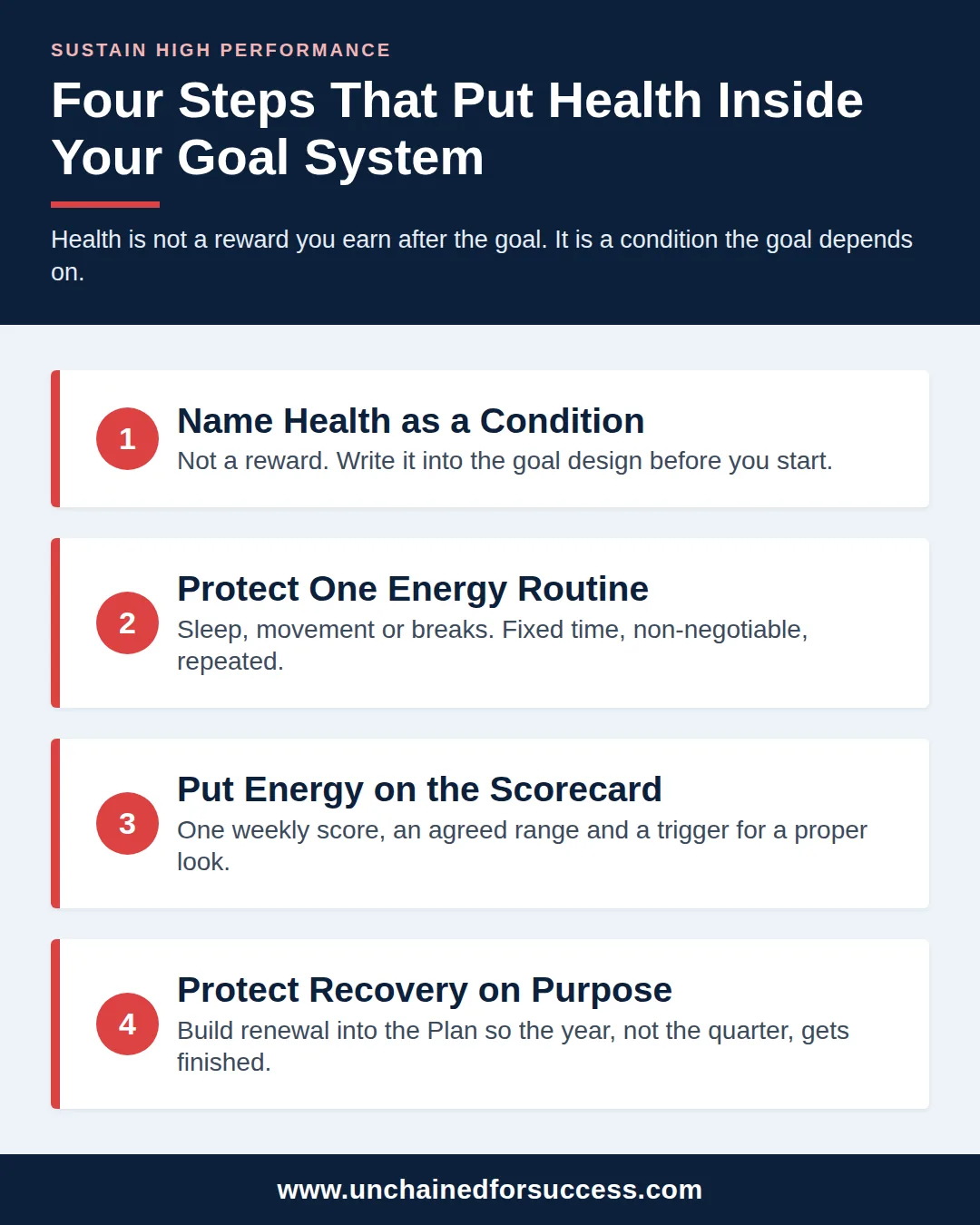
Four steps put health inside your goal system rather than beside it.
1. Name Health as a Condition, Not a Reward
Start by naming health as a condition of your goal, not a reward you earn after achieving it. The order matters. Health is what lets you finish, so it comes first, not last.
2. Protect One Energy Routine to Sustain High Performance
Protect one routine that guards your energy: sleep, regular movement, or breaks during deep work. Treat it as a discipline your Plan depends on, and make it a Habit by giving it a fixed time and letting repetition take over.
Schwartz and McCarthy describe such behaviours as rituals: practised on purpose and precisely scheduled. In the framework's terms, the value lies in their consistency rather than their intensity. Choose one, make it non-negotiable, and keep it.
3. Put Energy on the Scorecard to Sustain High Performance
Add one energy measure to your Control System, with an agreed range. Then ask a simple question each week: is my energy rising, holding or falling? If it is falling and meets the trigger you set, treat that as a signal to diagnose in order, starting with whether the routine that protects your energy actually happened, and correct the first layer that has failed before the work suffers. This keeps small dips from becoming long stalls.
Define what your score means and rate it consistently, alongside the quality and quantity of work completed. A weekly energy check can then be five questions. Is my energy rising, holding or falling? Which Habit is most at risk this week? Is my recovery matching my workload? What must I reduce, protect or restore? And what one health behaviour will protect my goal this week?
4. Sustain High Performance by Protecting Recovery
A year is long, and no system runs at full load without renewal. Recovery is not a break from performance. It is part of how you sustain high performance across the whole distance. The next post in this series, Design Recovery Habits That Sustain Your Performance, shows how to build it in.
Common Mistakes When You Try to Sustain High Performance
Planning as if your capacity never changes. Review workload and recovery when the demands on you change. A Plan sized for January's capacity will not fit a July that includes a house move, a new project or a sick child.
Waiting until energy collapses. Energy does not have to fail all at once to hurt you. It can thin slowly, and a Control System that never measures it will miss the decline until the work suffers.
Confusing exhaustion with commitment. Working beyond your limits can feel like dedication, yet the research on going without sleep suggests it degrades the attention your goals depend on. Depletion is not proof of effort. It is a threat to output. This is where Growth Without Burnout becomes important, because discomfort can grow you, while unmanaged depletion damages the system.
Protecting the Plan but neglecting the person. The Plan does not act. You act. Guard your health, and the Plan stays deliverable.
Sustain High Performance: Frequently Asked Questions
Is health a component of the Unchained Goals Framework? No. The nine components are Purpose, Vision, Goals, Why, Ownership, Beliefs, Plan, Habits and the Control System. Health is the condition of the person who operates them. It appears in the design through the Plan, which must rest on sustainable capacity, and in governance through any energy measure you choose to put on the scorecard.
How do I put energy on the scorecard without over-engineering it? Choose one signal you can rate quickly, such as a weekly energy score out of ten or nights of adequate sleep out of seven. Agree a range that counts as normal and a trigger, such as two weeks in a row below it. That is enough for the Control System to work with.
What if my energy is already falling? Do not push harder. Diagnose in order: did the energy routine happen, is the routine still capable of protecting your energy, is the measure telling you the truth, and does the Plan still fit the capacity you actually have? If all of those are sound, keep going in order through Beliefs, Ownership and your Why to the boundary of what you can govern. Correct the first layer that failed.
If the drift has run for months, Sustainable Success covers what pushing too hard costs and how to stop paying it.
Sustain High Performance for the Whole Year
You win goals over months, not moments. The people and teams who finish strong are not always the ones who started fastest. They are the ones who stayed powered when the year grew long. Health is what keeps the work consistent, keeps your judgement sound, and keeps your capacity intact from January to December.
So protect your energy the way you protect your Plan, because the Plan cannot carry itself. Build health into your goals as a condition, govern it as a measure, and renew it on purpose. Do that, and you will not merely chase results. You will sustain high performance, year after year.
Choose one health behaviour this week, give it a fixed time, and write down the energy measure you will review beside your goals. If you want an outside view of how your goals are designed, executed and governed, the Goals Readiness Score is an optional next step: 18 questions, under five minutes.
Share the one health behaviour most likely to protect your performance this month in the comments.
What is the one health behaviour that would protect your performance most this month?
Sources
• Manage Your Energy, Not Your Time by Tony Schwartz and Catherine McCarthy, Harvard Business Review, October 2007
• A Meta-Analysis of the Impact of Short-Term Sleep Deprivation on Cognitive Variables by Julian Lim and David F. Dinges, Psychological Bulletin, 136(3), 375 to 389, 2010. DOI 10.1037/a0018883
Continue Your Journey
Explore more resources from the Unchained Goals Framework: