

The second half of the year rewards endurance, not intensity alone. Yet it is easy to plan the work in detail and leave rest to chance. Unless you design recovery habits deliberately, rest becomes whatever time survives the schedule. Energy drains, output dips, and effort rises to fill the gap. Then the cycle repeats until something gives.
There is a better way. You can design recovery habits with the same discipline you apply to your goals. This post shows you how. First, it explains why planned rest supports results you can repeat. Next, it shows how the Unchained Goals Framework helps you build rest into your Plan and Habits. Finally, it gives you five steps that make rest planned rather than accidental.
Why You Should Design Recovery Habits
In Energy Management Beats Time Management Everytime, we saw that energy, not time, is what moves goals. In Sustain High Performance by Protecting Your Health, we showed that health is the base your results stand on. This post completes the series. Protection is defensive. Design is deliberate. When you design recovery habits, rest stops being a reaction to burnout. Instead, it becomes part of the structure that delivers results you can repeat.
The wider evidence agrees. Writing in Harvard Business Review, Achor and Gielan write that "the key to resilience is trying really hard, then stopping, recovering, and then trying again". The lack of a recovery period, they argue, "is dramatically holding back our collective ability to be resilient and successful". In short, stopping is not the opposite of performing. It is what lets the work repeat.
Sonnentag and Fritz analysed answers from 930 employees in workplaces ranging from public administration and schools to call centres and hospitals, and reported the results in the Journal of Occupational Health Psychology.
They found four separate ways of recovering: switching off from work, relaxing, taking on a challenge outside work, and having control over your own free time. Our reading: real rest means switching off fully, not just leaving the desk.
The study measured how people unwind, not how their work changed afterwards, so it describes what rest contains rather than proving that it lifts results. Even so, rest has clear ingredients. When you design recovery habits, you turn those ingredients into daily behaviour. Rest is not what happens when the work stops. Rest is what allows the work to continue.
Design Recovery Habits Instead of Assuming Them
The Unchained Goals Framework draws a sharp line between two kinds of capacity. Peak capacity is what you could achieve for a short time under ideal conditions. Sustainable capacity is what you can keep up week after week without breaking down.
It is easy to build a plan around peak capacity without noticing. It assumes the January version of you will show up every day until December: fresh, keen and undistracted. But that assumption fails quietly. By July, the plan feels heavier than it should, even though nothing about it changed. Strong plans rest on sustainable capacity instead.
That is where rest enters. Rest is not slack in the schedule. It is what preserves sustainable capacity over time. The principle is simple: endurance is designed, not assumed. Motivation is not constant. Discipline is not infinite. Energy must be renewed. So the framework gives rest a place in the structure itself.
The question, then, is not whether you will rest. Your body and mind will force the issue at some point. The real question is whether rest happens by design, at moments you choose, or by collapse, at moments you do not. Recovery habits you design in advance settle that question for you.
How the Unchained Goals Framework Helps You Design Recovery Habits
Three framework components carry most of the design work: the Plan, Habits and the Control System.
Design Recovery Habits Into the Plan
The Plan defines the order of the work, its trade-offs, what depends on what, and the time and energy you actually have. A Plan built around peak capacity is fragile, because it cannot absorb pressure. So plan rest on purpose. Place it in the order of the work as a protected commitment, not a leftover. Rest blocks then appear in the calendar before the work expands to erase them.
Design Recovery Habits That Survive Pressure
Habit Conversion turns the behaviours in your Process Goals into routines that need less deciding each time, so execution depends less on motivation week by week. Once a rest behaviour is a Process Goal, it must pass through the same conversion. A rest day you negotiate with yourself each week is the easiest thing to lose under pressure.
Once it becomes a Habit, it needs far less weekly bargaining. As a result, it is more likely to survive busy periods. Habits designed without rest wear performance down in the end. That is why you design recovery habits rather than merely intend them.
Design Recovery Habits the Control System Can See
The Control System compares your agreed measures with their operating range. It reviews the Performance measures you agreed against their operating range, and it keeps enough record of your Process behaviours to diagnose a drift when one appears. So rest has to be defined in one of those two places.
If sleep consistency is a genuine early warning of your capacity to deliver, you can deliberately make it one of your Performance measures, with its own range. Otherwise, keep a simple record of what you control, so the answers are there when you need them: was the shutdown routine completed, was the agreed stopping time kept, and did the protected rest take place?
When a measure falls outside its range and meets the trigger you agreed in advance, Diagnose Mode begins. The questions run in a fixed order, from the layer closest to daily behaviour upward. Did the rest behaviour actually happen? Can the routine as designed produce the standard? Is the measure the right one?
Only then do you look at the Plan, the Beliefs the goal depends on, whether you still accept its cost (Ownership) and whether the goal is still worth that cost (Why). The last question is whether the result still sits within your authority. As a result, you fix the layer that failed instead of demanding more effort from the whole system.
Design Recovery Habits to Keep the Execution Spine Running
Together, these components keep the Directional Execution Spine running: the Plan and the Control System protect it, and Habits complete it. The spine is the sequence that turns a goal into repeated action through the Outcome Goal, the Performance Goal, the Process Goal and Habits. The spine is the only part of the framework that produces measurable movement, and it runs on repetition. Rest keeps up the capacity that repetition needs.
Remove adequate rest, and the spine may not stop at once. Capacity can fade slowly before the damage shows in your results. Design the rest, and the results repeat.
Three Examples of How to Design Recovery Habits
Here is what designed recovery habits look like at three scales. The examples show the principle rather than set fixed rules, and the people in them are examples, not clients.
Design Recovery Habits for the Individual
A consultant sets a hard stop at 6.30 pm three evenings a week. A fixed shutdown routine turns the stop into a Habit. She also keeps one weekend day fully detached from work, a recovery habit she designed in a quiet month and has defended since.
Each week she records both: the stops kept and the day protected. She has deliberately made these two counts her early-warning measures, each with an agreed minimum, because a missed stop shows up long before a missed deadline does. Each week she reviews the pattern.
Her agreed trigger is two weeks in a row below either minimum. When it fires, she does not cut commitments on instinct. She works through the questions in order. First, what stopped the routine: was the 6.30 pm cue in place, and would a shorter shutdown have held? Next, does the routine as designed still protect her evenings, and do the two counts still tell her what she needs to know?
Only if the Habit is sound and the measures are right does the question move to her Plan. If the work simply no longer fits the capacity she planned around, she cuts commitments before tired energy hurts her results.
Design Recovery Habits for the Business
A leadership team designs rest into the operating rhythm. Fridays carry no internal meetings. After major launches, the team schedules a lighter period that matches the pressure and the delivery risk. The team agrees this in advance, rather than asking for it only after people burn out.
Each quarter the team reviews whether it kept the meeting-free period, alongside its Performance measures. Above all, the business treats rest and performance as one system, because a worn-out team cannot deliver strategy reliably.
Design Recovery Habits for the Project
A project manager builds sprint and rest cycles into the delivery plan. A lighter phase for notes, review and tidy-up follows each intense phase. The pace is honest about sustainable capacity. So the team finishes the project able to start the next one. The pace may look slower at first. But it protects output across the year, keeps decisions sharp, and leaves the team ready for what comes next.
I have seen this pattern in my own programme delivery work. Working flat out without a pause increased rework and weakened later decisions. The answer was not reduced ambition. Instead, we built review, notes and lighter work into the order of delivery. As a result, the team could sustain performance across the programme.
How to Design Recovery Habits in Five Steps
Here are five steps you can take this week.
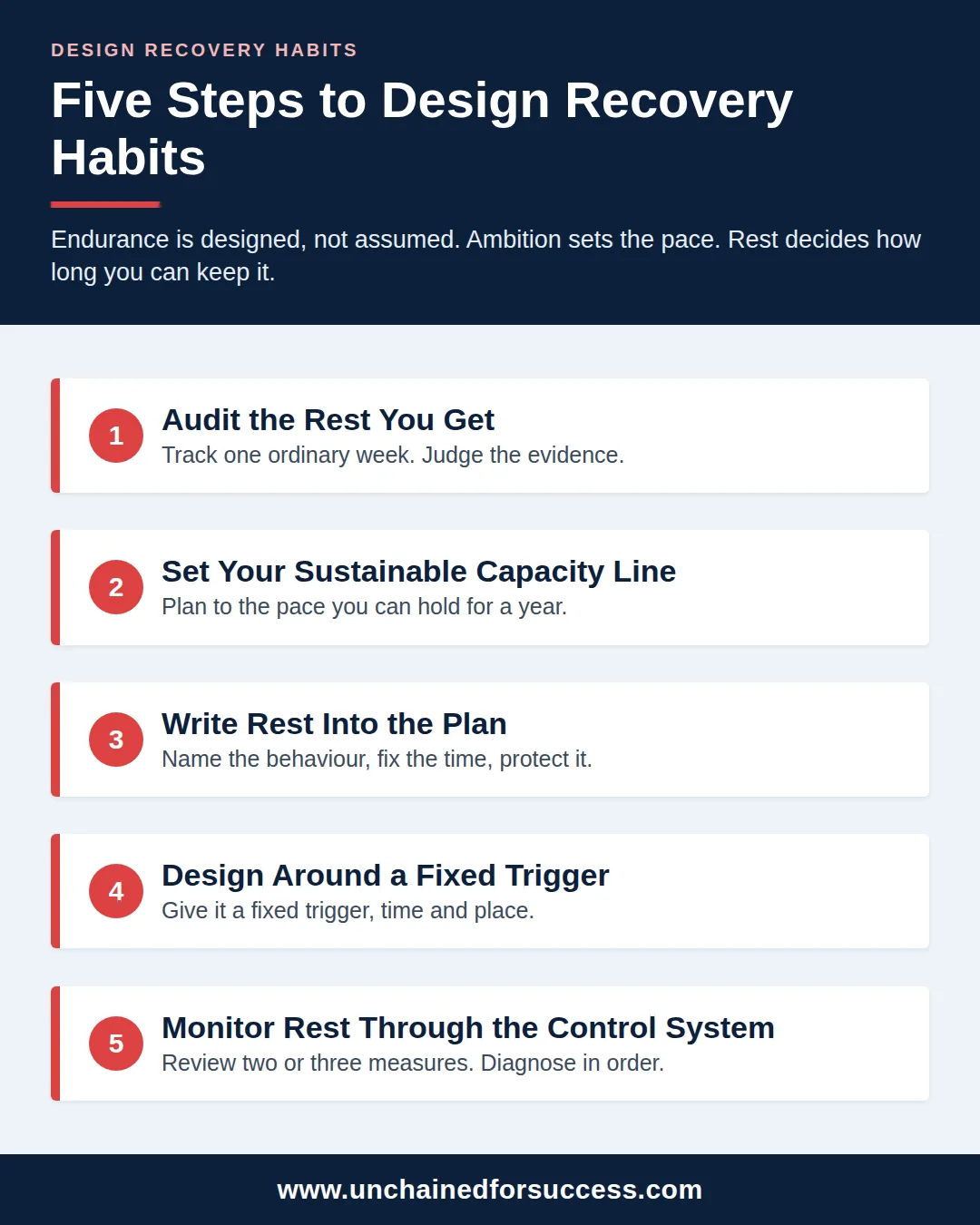
1. Audit the Rest You Get
Track one ordinary week. Record sleep, breaks, evenings and detached time. Then judge the evidence, not the intention.
2. Set Your Sustainable Capacity Line
Ask what pace you could hold for twelve months without breaking down. Plan to that line, not to your best fortnight. If you are not sure where the line is, the post on capacity before goals shows how to find it.
3. Write Rest Into the Plan
Where rest protects a Performance standard you have defined, convert it into a controllable Process Goal. Name the behaviour, fix the time, and protect it. For example, "sleep for eight hours" describes a result you want. It does not define the behaviour you will perform. "Complete my shutdown routine at 10 pm and be in bed by 10.30 pm" defines a controllable Process Goal.
4. Design Recovery Habits Around a Fixed Trigger
Design each recovery habit around a fixed trigger, time and place. A shutdown ritual at 6.30 pm beats a vague plan to finish earlier. The trigger is what makes the behaviour far more likely to repeat when you least feel like it.
5. Monitor Rest Through the Control System
Choose two or three measures and review them alongside your Performance Goals. When a below-range signal meets your agreed trigger, start with whether the rest behaviour happened, then work up through the questions in the order above. Correct the first layer that failed rather than demanding more discipline from the whole system. If the drift has run for months, the post on handling setbacks without losing direction walks through the recovery in order.
Common Mistakes When You Design Recovery Habits
Treating rest as a reward. Rest that waits until everything is finished is waiting for a moment ambitious work does not offer. Rest is a requirement of the system, not a prize from it.
Confusing distraction with rest. An evening of scrolling keeps the mind lightly tied to stimulation. The research describes recovery in four parts: switching off, relaxing, a challenge outside work, and control over your time. So choose activities that deliver them.
Cutting rest first under pressure. When strain increases, durable Habits shrink in scope rather than disappear. Reduce or move the rest commitment when you truly must. But do not let short-term pressure remove rest from the structure altogether. The post on sustainable success shows what that removal costs.
Planning at peak capacity. If your plan only works when everything goes well, it does not work. If you have seen the warning signs described in Outgrown Your Capacity? 7 Signs to Watch For, your plan is already telling you this.
Waiting for burnout to signal the need. By the time exhaustion shows in your results, the drift may have been building for weeks. Early-warning measures let you act while the fix is still cheap.
Design Recovery Habits: Frequently Asked Questions
How much rest is enough? Enough to hold your sustainable capacity line for twelve months. The test is not a number of hours; it is whether the pace you are keeping could continue without the warning signs in your measures. Audit a week, set the line, and adjust from evidence.
Is a recovery habit really a Habit in the framework's sense? Yes, when it converts a controllable Process behaviour. "Complete the shutdown routine at 10 pm" is a Process Goal you can perform; once it runs on a fixed trigger with little fresh deciding each time, it has become a Habit. "Feel rested" is a result, not a behaviour, so it cannot be one.
What if I design recovery habits and my output falls? Check the measure before the conclusion. A short dip may occur while a new routine settles; a sustained fall below your agreed range is a signal to diagnose in order, starting with whether the planned behaviours happened. The post on growth without burnout draws the line between healthy discomfort and real damage.
Design Recovery Habits and Make Rest Part of the Machine
High performance is not a sprint you win by refusing to stop. Rather, it is a rhythm you sustain by deciding when to stop. When you design recovery habits, you convert rest from an apology into an asset. Your plan gains honesty. Your Habits gain durability. And your goals gain a full year of you, not just a strong January.
Build recovery habits now, while you still have the energy to build them. The second half of your year depends less on how hard you can push. It depends more on how well you can repeat the push. Ambition sets the pace. Rest decides how long you can keep it.
Choose one rest behaviour this week, give it a fixed time and trigger, and put it in the calendar before the work does. If you want an outside view of how your goals are designed, executed and governed, the Goals Readiness Score is an optional next step: 18 questions, under five minutes.
Share the recovery habit you have chosen in the comments.
Which recovery habit would protect your performance most during the second half of this year?
Sources
• Resilience Is About How You Recharge, Not How You Endure by Shawn Achor and Michelle Gielan, Harvard Business Review, 24 June 2016
• The Recovery Experience Questionnaire: Development and Validation of a Measure for Assessing Recuperation and Unwinding From Work by Sabine Sonnentag and Charlotte Fritz, Journal of Occupational Health Psychology, 12(3), 204 to 221, 2007. Full text at the University of Konstanz repository
Continue Your Journey
Explore more resources from the Unchained Goals Framework: