


You have probably tried this before. A new routine starts well, holds for eleven days, then a difficult week arrives and it quietly stops. The usual advice on daily self-leadership habits says get up earlier and want it more.
That advice has almost nothing behind it. What does have evidence behind it is smaller, duller and far more likely to work. It comes down to two things: what starts the behaviour, and how long you give it. Daily self-leadership habits that survive a bad week are built on those two, not on resolve.
What Makes a Routine Actually Fire
Start here, because this is the part people get wrong first.
Researchers randomly assigned 192 adults to one of two planning conditions (Keller and colleagues, 2021). Everyone picked an everyday eating behaviour they wanted to establish. One group linked it to a time of day. The other linked it to something they already did each day.
Automaticity rose in both groups, and neither cue beat the other. The behaviour studied was a nutrition one, so carry the comparison across rather than the size.
That is genuinely good news for anyone starting daily self-leadership habits, because it means you are not choosing wrongly. A clock time works. So does a place, a preceding action, or a condition you can recognise. What decides it is whether the cue actually happens.
So test the cue behind your daily self-leadership habits against an ordinary bad week. Does it still occur when a meeting overruns, a child is ill, or you are travelling? "After I make the first coffee" survives most weeks. "At 6.30, before the house wakes" survives fewer of them than people expect. Pick the one that keeps firing when the week goes wrong, because that is the week the routine is for.
The Sentence That Does the Work
If you take one practical thing from this article, take this one.
Deciding in advance when, where and how you will act has been tested on a very large scale. An early meta-analysis pooled 94 independent tests and found a medium to large effect on follow-through (Gollwitzer and Sheeran, 2006). The current update covers 642 tests (Sheeran, Listrom and Gollwitzer, 2025).
The form is plain. When this specific thing happens, I will do that specific thing.
"When I sit down after the school run, I will write for twenty-five minutes." "When I close my laptop on Friday, I will update the project log." Both name a trigger you cannot miss and an action you cannot argue with.
Compare that to "I will write more this term", which names no moment at all, so the decision has to be made again every day. Most failed daily self-leadership habits are not a willpower problem. They are a missing sentence.
Two things the sentence does not contain are worth noticing. No hour, unless an hour is your cue. And nothing about the kind of person you are.
How Long Daily Self-Leadership Habits Take
This is where daily self-leadership habits are most often abandoned, and it is avoidable.
The well-known study of everyday habit formation found the time to reach near-automatic performance ranged from 18 days to 254 (Lally and colleagues, 2010). The famous 66 is a median, drawn from the 39 of 96 participants whose data fitted the model well.
A recent review pooled 20 studies covering 2,601 people (Singh and colleagues, 2024). Four of those reported a median or mean time. The medians landed between 59 and 66 days, the means between 106 and 154, and individual times ran from 4 days to 335.
Read the range, not the median. If your routine still takes effort after four months, you are inside the ordinary spread. Expecting 66 days is exactly how people conclude at week six that something is wrong with them.
So set the review months out, not weeks out. Judge your daily self-leadership habits on whether the behaviour is happening, rather than on whether it has started to feel effortless. Those are different questions and only the first one is any of your business early on.
One honest note from that same review: habits practised in the morning tended to come out stronger. It is an association across a small and varied set of studies rather than a trial, so it does not settle the timing question. It does mean the question is open.
Why Daily Self-Leadership Habits Do Not Run on Willpower
This one changes how you plan your week, and how you think about daily self-leadership habits altogether.
You will still read that willpower is a fuel tank that empties, so discipline has to be rationed. Two very large preregistered tests have now looked for that effect. One pooled 23 laboratories and 2,141 people (Hagger and colleagues, 2016). The other pooled 36 laboratories and 3,531 people (Vohs and colleagues, 2021). Neither found a reliable effect, and the second was co-authored by one of the theory's own architects.
Keep one detail. An exploratory analysis in that second test did find a small effect, larger among people reporting fatigue. So read it as too small and unreliable to plan around, not as a proven zero.
The practical consequence is liberating. If there is no reserve to protect, then arranging your week so you need less resolve is not cheating. It is the method, and it is what daily self-leadership habits are for. Put the thing where it costs least to start: the tools already open, the gym bag already packed, the document already on the screen.
What About Rising Early?
It deserves a straight answer, because the whole genre of daily self-leadership habits is built on it.
When you naturally wake is partly something you are. A study of 697,828 people found 351 genetic regions linked to being a morning person, with heritability around 14 per cent (Jones and colleagues, 2019). Most of the variation sits elsewhere, so treat chronotype as a starting position rather than a verdict. That study does report one causal finding favouring morning types, on mental health rather than performance.
The study people most often reach for does not carry the weight put on it. In it, 26,820 adults completed cognitive tests and evening and intermediate types scored higher (West and colleagues, 2024).
But the design is cross-sectional and the effects are small. Independent experts criticised the reporting at the time, one saying plainly that it cannot tell us anything about the impact of sleep on cognition (Science Media Centre, 2024). So it does not show night owls are sharper, and by the same logic it cannot show the reverse.
Meanwhile a study of 20 field hockey players found physical performance tracking hours since they woke rather than clock time (Facer-Childs and Brandstaetter, 2015). Twenty athletes, one sport, physical output, so a lead rather than a law.
Put together, nobody has shown that rising early confers an edge at work. That is not the same as showing there is none. It is enough to stop you building your daily self-leadership habits around an alarm clock and calling the result discipline.
What Daily Self-Leadership Habits Cannot Do For You
Here is the limit of what daily self-leadership habits can do, and it is the one that costs people whole quarters.
In the Unchained Goals Framework a routine is a behaviour you have repeated enough that starting it costs less deciding. That is all it is. It makes the behaviour cheaper to run. It says nothing about whether the behaviour was the right one.
So a routine answers upwards through two steps. The behaviour it makes cheap has to be the right behaviour for the job, and that behaviour then has to produce the standard sitting above it, which you check on a schedule. Repetition settles the first step only.
You can repeat something faithfully for six months and find the number unmoved, because what you made effortless was never what moves it. The framework glossary sets out the rest.
Which gives you two questions for the review of any daily self-leadership habits you run, instead of the one people ask. Not "does this feel automatic yet", but "is the standard moving" and "is this still the behaviour most likely to move it".
What Other People Actually See
Worth saying, because articles on daily self-leadership habits usually end with "your habits are your leadership".
Where people see a gap between what a manager says and what that manager does, trust, commitment and willingness to go beyond the role all sit lower (Simons and colleagues, 2015). Most of that research measures perceptions at a single point, so read it as a pattern rather than a proven chain.
Note what it measures, though: how far words and deeds line up as the people around you perceive it, at work. A private morning routine has no route into that judgement, because nobody can see it.
What colleagues respond to is whether you did the thing you said you would, by the day you said. Your routine matters to them only through that.
Building Daily Self-Leadership Habits This Week
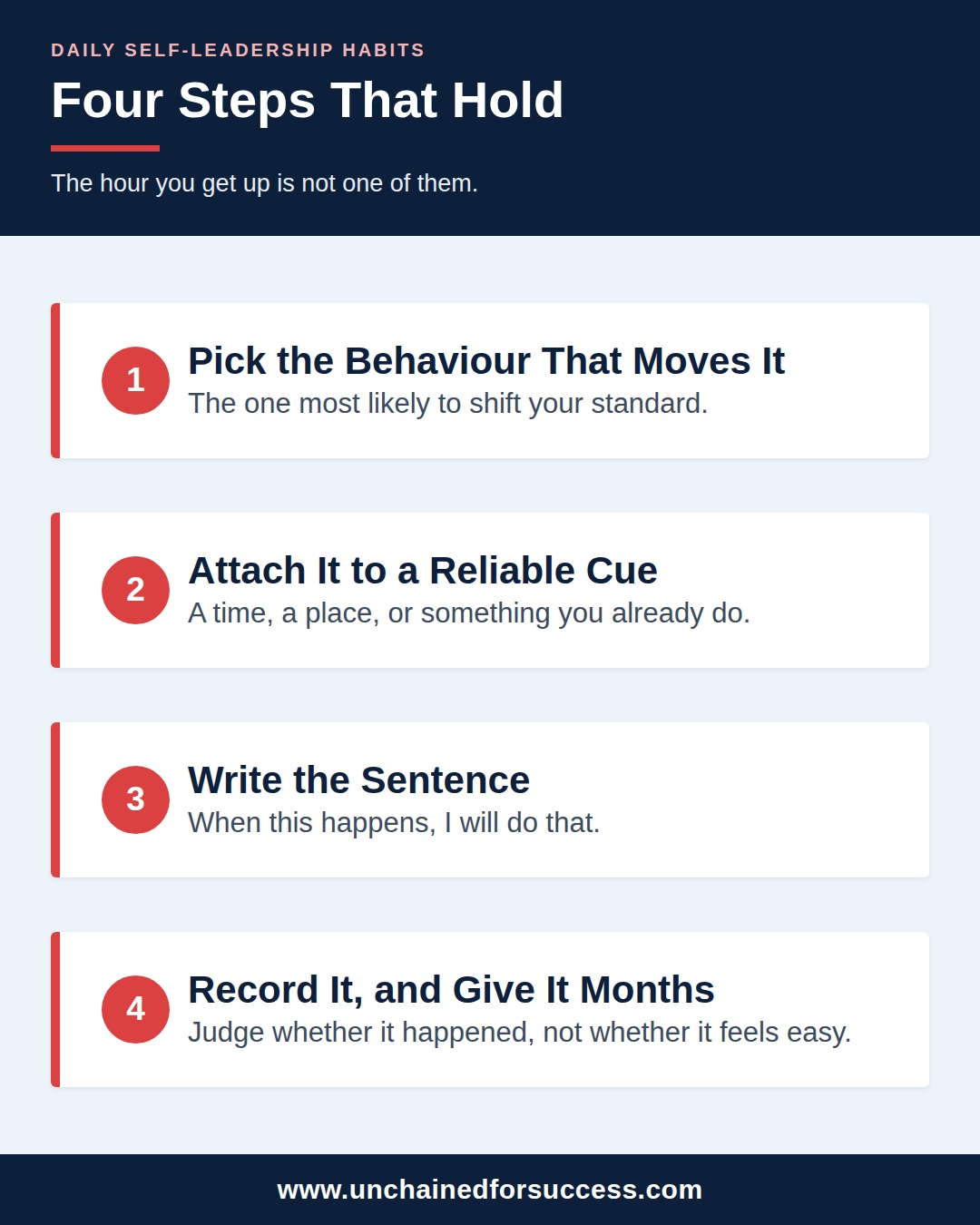
Four steps, and the hour you get up is not one of them.
1. Pick the behaviour most likely to move a standard you are already tracking.
2. Attach it to a cue that reliably fires, whether that is a set time, a place or something you already do.
3. Write it as a plain sentence: when this happens, I will do that.
4. Record whether it happened, and expect the settling to take months rather than weeks.
Then lower the cost of starting, once. Whatever the behaviour needs, have it ready before the cue arrives. That single act does more for daily self-leadership habits than any amount of resolve.
If it breaks down, handling the setback without losing direction is a better response than moving your alarm earlier. For the wider question of what leading yourself actually means, see building self-leadership.
Frequently Asked Questions
What if I miss a day? Carry on at the next scheduled opportunity. The habit-formation study above found that missing a single opportunity did not materially affect the process, and treating one gap as a failure is how people abandon something that was working.
Should I try to become a morning person? Only if it suits your life, and not because you think it makes you a better leader. Chronotype is partly heritable, and no study cited here demonstrates that rising early produces an edge at work.
Does the time of day matter at all? The randomised trial above compared a clock cue against a routine cue and found neither ahead, so the kind of cue is not the deciding factor. The review of 20 studies did find morning practices tended to be stronger, which leaves the question open. Choose the cue you can depend on in an ordinary week.
How many should I run at once? One at a time until it costs little to start. That is my own rule rather than a finding, and the reason is diary space rather than willpower. Several behaviours can share one cue if they genuinely run as a sequence, but starting six at once asks six separate moments to hold. Two things you actually do beat six you intended to.
Share the one behaviour you are going to attach to a cue this week, in the comments.
If you want an outside view of how your goals are designed, executed and governed, the Goals Readiness Score scores each of the nine components separately and names the weakest one.
Which of your routines would anyone else be able to notice?
Sources on Daily Self-Leadership Habits
- Keller, J., Kwasnicka, D., Klaiber, P., Sichert, L., Lally, P., and Fleig, L. (2021). Habit formation following routine-based versus time-based cue planning: a randomized controlled trial. British Journal of Health Psychology, 26(3), 807 to 824. https://doi.org/10.1111/bjhp.12504
- Gollwitzer, P. M., and Sheeran, P. (2006). Implementation intentions and goal achievement: a meta-analysis of effects and processes. Advances in Experimental Social Psychology, 38, 69 to 119. https://doi.org/10.1016/S0065-2601%2806%2938002-1
- Sheeran, P., Listrom, O., and Gollwitzer, P. M. (2025). The when and how of planning: meta-analysis of the scope and components of implementation intentions in 642 tests. European Review of Social Psychology, 36(1), 162 to 194. https://doi.org/10.1080/10463283.2024.2334563
- Lally, P., van Jaarsveld, C. H. M., Potts, H. W. W., and Wardle, J. (2010). How are habits formed: modelling habit formation in the real world. European Journal of Social Psychology, 40(6), 998 to 1009. https://doi.org/10.1002/ejsp.674
- Singh, B., Murphy, A., Maher, C., and Smith, A. E. (2024). Time to form a habit: a systematic review and meta-analysis of health behaviour habit formation and its determinants. Healthcare, 12(23), 2488. https://doi.org/10.3390/healthcare12232488
- Hagger, M. S., Chatzisarantis, N. L. D., and colleagues (2016). A multilab preregistered replication of the ego-depletion effect. Perspectives on Psychological Science, 11(4), 546 to 573. https://doi.org/10.1177/1745691616652873
- Vohs, K. D., Schmeichel, B. J., Lohmann, S., and colleagues (2021). A multisite preregistered paradigmatic test of the ego-depletion effect. Psychological Science, 32(10), 1566 to 1581. https://doi.org/10.1177/0956797621989733
- Jones, S. E., Lane, J. M., Wood, A. R., and colleagues (2019). Genome-wide association analyses of chronotype in 697,828 individuals provides insights into circadian rhythms. Nature Communications, 10, 343. https://doi.org/10.1038/s41467-018-08259-7
- West, R., Wong, R. T. C., Park, J.-E., and colleagues (2024). Sleep duration, chronotype, health and lifestyle factors affect cognition: a UK Biobank cross-sectional study. BMJ Public Health, 2(1), e001000. https://doi.org/10.1136/bmjph-2024-001000
- Science Media Centre. (2024). Expert reaction to study on sleep, chronotype and cognition. https://www.sciencemediacentre.org/expert-reaction-to-study-on-sleep-chronotype-and-cognition/
- Facer-Childs, E., and Brandstaetter, R. (2015). The impact of circadian phenotype and time since awakening on diurnal performance in athletes. Current Biology, 25(4), 518 to 522. https://doi.org/10.1016/j.cub.2014.12.036
- Simons, T., Leroy, H., Collewaert, V., and Masschelein, S. (2015). How leader alignment of words and deeds affects followers: a meta-analysis of behavioral integrity research. Journal of Business Ethics, 132(4), 831 to 844. https://doi.org/10.1007/s10551-014-2332-3
Continue Your Journey
Explore more resources from the Unchained Goals Framework: