
A client goes under owing you money. Your manager cancels the project you led. A supplier lets you down a week before a deadline. Setbacks outside your control hurt in a particular way, because the usual advice does not fit. Learning from it will not reverse someone else's decision, and trying harder will not undo it.
Who caused it may matter. Alongside that, ask what is still yours to govern. That part is often bigger than it feels on the first day.
You do not control the setback. You still control what you do with the week after it.
Why Setbacks Outside Your Control Feel Different
When someone else caused the setback, two reactions are tempting, and both cost time.
The first is to wait: for an apology, for the money, for things to go back to how they were. The second is to take on blame that is not yours, as if you should have seen it coming. Waiting hands your next move to the person who caused the problem. Taking all the blame sends you looking for a fault in yourself that may not be there.
Take an illustrative case. A self-employed bookkeeper has five clients. In October the largest, a retailer worth 40 per cent of her income, goes into administration owing her two months' fees. She did good work and still lost the client.
Step 1: Sort What Happened Into Three Lists
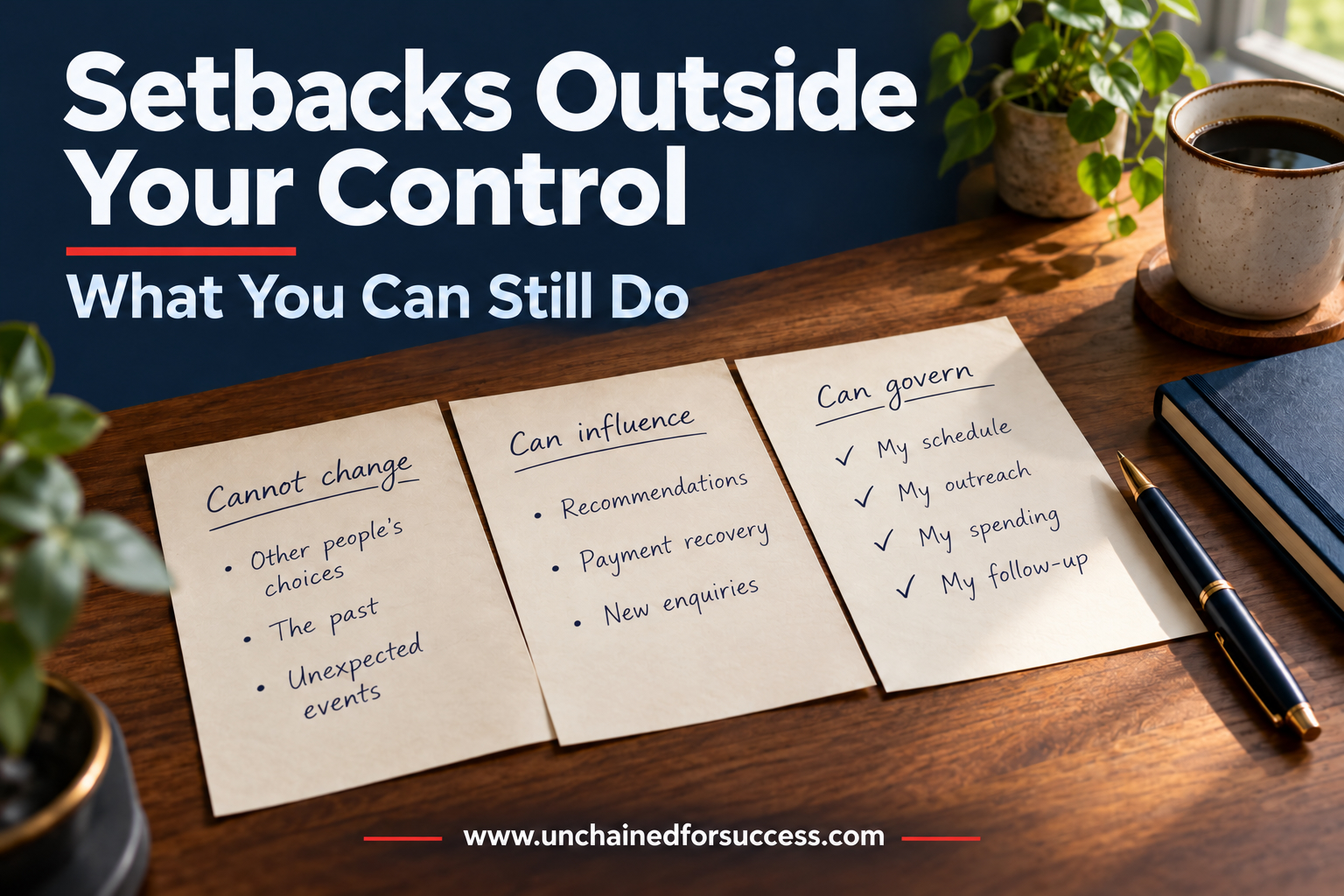
On the first evening she wrote three lists.
• Cannot change: the administration, the decision to stop trading, the timing.
• Can influence: whether she recovers the unpaid fees, and whether the retailer's finance team recommend her elsewhere.
• Still hers to govern: her cash plan, her time, her prices, and how many suitable prospective clients she approaches each week.
The framework calls the line between the third list and the other two your control boundary: the results you have enough authority to govern, as distinct from those you can only influence or desire. Governing a result does not mean removing every risk. It means having enough authority over the main inputs and the decisions needed to correct course.
The lists stop her spending energy on the first, and show her that the third is long.
Step 2: Protect What You Govern First
Her savings would cover her costs for about three months without the lost income. She moved one non-urgent purchase to the new year, told her four remaining clients nothing had changed in her service, and set a rule: if her balance fell below six weeks of costs, she would activate her contingency plan: seek temporary cover work and make further spending cuts.
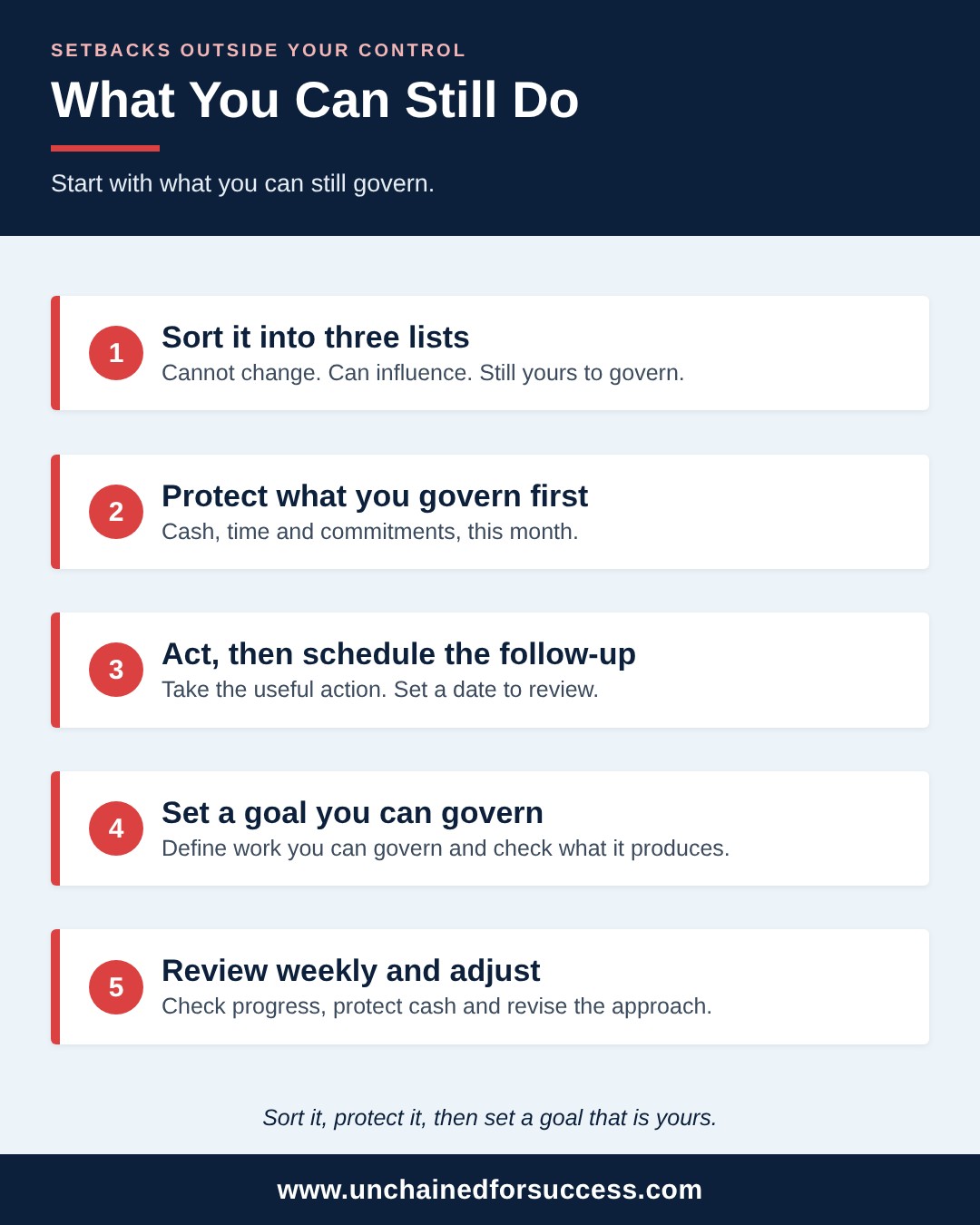
Setbacks outside your control can hit cash, time and commitments first. Protect those before you plan the comeback.
Step 3: Act, Then Schedule the Follow-Up
Influence is worth using. The weakness is a plan that depends on the reply. She filed her claim with the administrator the same week and asked the retailer's finance director, whom she had worked with for three years, for a recommendation. She noted the deadlines, set follow-up dates, and went back to work she could progress without either reply.
Use your influence deliberately, but keep your next move independent of the answer.
Step 4: Set a Goal You Can Govern
She wanted to replace the lost income by Christmas. But she could not make a particular business hire her, and she had no proven route to that result yet. So she kept the result in view and committed to work she could govern.
By 31 January she would complete an outreach campaign to 60 suitable local businesses, each with a first approach, a follow-up a week later and a recorded next step.
Her weekly standard was five new approaches plus the follow-ups falling due. She did them on Tuesday and Thursday mornings, 9 am to 11 am, having timed each business at about 40 minutes for research, approach, follow-up and the record. Conversations and proposals went into Friday mornings. At five a week, 60 takes twelve of the thirteen weeks left.
She also tracked conversations, proposals and new monthly income, so she could see whether the campaign was closing the gap. And she chose a longer-term limit for her business: over time, no single client above a quarter of her income.
Step 5: Review Weekly and Adjust
Every Friday she checked the approaches and follow-ups done, the conversations they produced, and her cash against her six-week line. When a week fell short, she first asked whether the Tuesday and Thursday sessions had happened. If the sessions happened but produced few useful conversations, she checked which businesses she was choosing and what she was saying before she added more.
By mid-December she had contacted 35 businesses, had nine conversations (one from the finance director's recommendation), sent four proposals and won two new clients. Together they covered about half the lost income, so she kept checking the gap. Her balance never reached the six-week line. The unpaid fees were still with the administrator.
She kept pursuing what she was owed, but stopped making her recovery depend on receiving it.
What the Research Says About Setbacks Outside Your Control
A meta-analysis of 329 studies by Cheng, Lau and Chan found a small to moderate link between flexible coping and better adjustment after stressful life changes, and a moderate one where flexibility meant fitting the response to the situation. That supports adapting your response; it does not show that these five steps cause better outcomes.
In three studies by Wrosch and colleagues, people who could step back from an unattainable goal and commit to a new one reported higher well-being. The samples were small and the studies did not test cause. The research concerns goals that have become unattainable, not goals that have simply become harder.
Common Questions About Setbacks Outside Your Control
What if the setback is partly my fault?
Many setbacks have mixed causes. Put your part on the third list and fix it. Then separate what you cannot change from what you can still influence.
Does this work for setbacks outside your control at work?
Yes. If your employer cancels your project, the decision goes on the first list, the case for your next role on the second, and your skills, contacts and next application on the third.
How do I stop going over it?
The lists and follow-up dates will not stop difficult thoughts, but they give your attention somewhere to go. When the setback comes back to mind, check whether a follow-up is due. If it is not, return to the work you govern.
Act on Setbacks Outside Your Control This Week
• Write the three lists: cannot change, can influence, still govern.
• Protect your cash, time and commitments this month, with a line that triggers action.
• Take the useful action, schedule the follow-up and continue with what you govern.
• Set work you can govern, and track whether it is closing the gap.
• Review every week, adjust the approach and stop making progress depend on replies you cannot control.
To see where your own goals depend on things you do not govern, try the Goals Readiness Score: 18 questions, about ten minutes, with your results after the contact details step.
Which setback are you waiting on someone else to fix?
Further Reading
These ideas draw on the Unchained Goals Framework. For related guidance on diagnosing setbacks, learning from failure and rebuilding momentum, see Handling Setbacks Without Losing Direction, Why Failure Isn't the Real Problem and Recovering Momentum After Disappointment. Terms: control boundary and control boundary translation.
Sources
• Cheng, C., Lau, H. B. and Chan, M. S. (2014). "Coping flexibility and psychological adjustment to stressful life changes: a meta-analytic review." Psychological Bulletin, 140(6), 1582-1607. Available at: https://doi.org/10.1037/a0037913.
• Wrosch, C., Scheier, M. F., Miller, G. E., Schulz, R. and Carver, C. S. (2003). "Adaptive self-regulation of unattainable goals: goal disengagement, goal reengagement, and subjective well-being." Personality and Social Psychology Bulletin, 29(12), 1494-1508. Available at: https://doi.org/10.1177/0146167203256921.
Continue Your Journey
Explore more resources from the Unchained Goals Framework: