


A year-end reflection can produce a useful list of wins and disappointments and still leave next year's goals unchanged. The year taught you something, but the lesson never reached the goals you set next. The missing step is turning what you learn into a decision.
A year-end reflection that carries into the coming year does one thing differently. It compares what you set out to do with what you did, goal by goal, and decides which goals stay, what should continue, and what needs to change.
This article gives you that method. It takes about an hour, it needs the year's goals and a calendar, and it ends with a short list of changes rather than a long list of feelings.
A useful reflection tells you what to continue, what to change and what to stop.
Where a Year-End Reflection Goes Wrong
Questions about what went well and what went badly are useful, but they become more valuable when you connect the answers to specific goals, commitments and results. "I over-committed" may be an accurate finding. It becomes useful when you identify which commitments exceeded your available time, and what you will change.
Research supports learning through debriefing. Tannenbaum and Cerasoli (2013) pooled 46 samples of individual and team debriefs, mostly in medical and simulation settings, and found that debriefing improved performance by about a quarter. The debriefs in those studies looked at specific events, not general impressions.
The exercise below applies that general principle to reviewing your goals. It has not itself been tested by that research. What transfers is the shape of a useful review: specific events, a comparison with what you intended, and a decision at the end.
Start Your Year-End Reflection With What You Set
Open the goals you set at the start of the year, or the nearest thing to them. A note on your phone, a plan from a January conversation, a list in a notebook. If you set nothing in writing, write down now what you were trying to do, as honestly as you can. The method still works; it just starts with a weaker record.
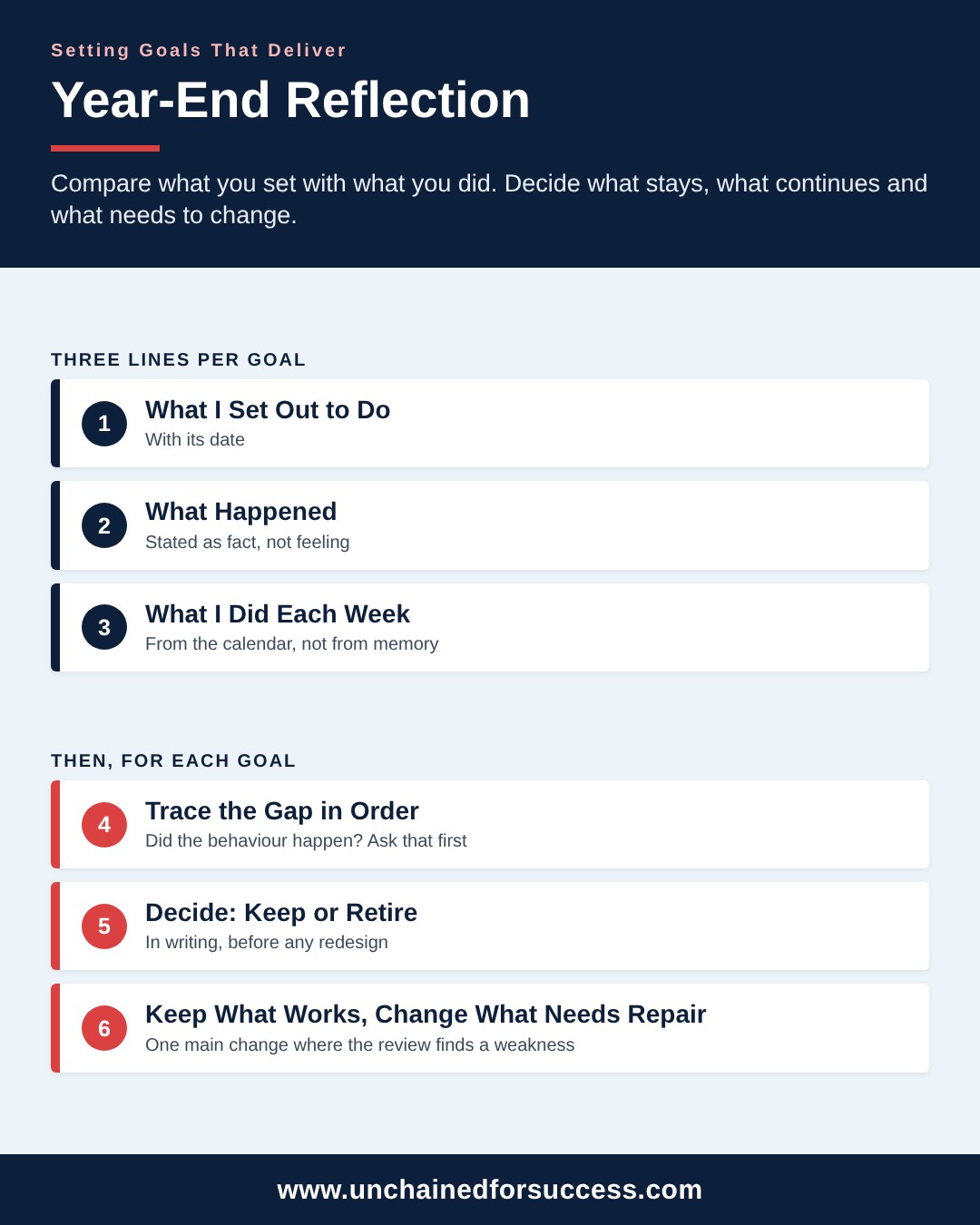
For each goal, write three lines.
1. What I set out to do, with its date if it had one.
2. What happened by the end of the year, stated as fact. Submitted, not submitted. Twelve runs, not "I ran a bit".
3. What I did each week towards it, as far as you can reconstruct from your calendar, messages and files. If you set a weekly standard, note how actual progress compared with it.
The third line is the easiest to skip, and it is the one that produces the lesson. Forty weeks of effort and four weeks of effort call for different questions. Neither tells you the cause until you examine what happened.
An example. A teacher set out to submit all four modules of a leadership qualification by December. By year end she had submitted two. Her calendar showed study blocks in January and February, then almost none until September. Three lines, and the shape of the year is already visible.
Find the Gap, Then Find Its Cause in Order
Where the second line falls short of the first, you have a gap, and this is where a year-end reflection starts to earn its hour.
Where the second line matches or beats the first, ask a different question: what should you repeat, and what did success cost? A goal met on excessive hours, neglected responsibilities or luck needs a design change as much as a missed one.
For the gaps, do not reach for the first explanation that comes to mind. Work through the causes in a fixed order, from the cheapest repair to the most expensive.
1. Did the weekly behaviour happen? Check the third line.
2. If it happened, was it the right behaviour? Twenty weeks of reading is not twenty weeks of writing assignments.
3. Was the standard the right measure of progress?
4. Only then: was the plan sound, what beliefs shaped how you acted, do you still accept the cost and consequences, and do the expected benefits still justify them?
5. Last of all: was the result within your authority to deliver?
The teacher's gap stopped at the first question. Her behaviour had largely stopped between March and August, because the study blocks stopped going into the diary once the term got busy after February. So the diagnosis did not need to go further. Her goal as set had a result and a date but no behaviour that survived a busy term.
That is a different lesson from "I lacked discipline", and it points to a different change.
Keep What Works, Change What Needs Repair
Decide first whether the goal stays, using the test in the next section. Keep what is working: a retained goal that is sound, sustainable and progressing needs no redesign, and a year-end reflection does not have to produce changes to justify its hour.
Where the review reveals a weakness, choose one main corrective change, then adjust the supporting arrangements needed to make it work. Name what will be different in the design, not in your attitude.
The teacher's main change: plan the study around term-time capacity, with the blocks in the diary before the term timetable is. Her reason for the qualification, a head of department role, still held, so the goal stayed.
The Supporting Arrangements
The two remaining modules, four assignment sections each, are submitted by the end of March. Her standard is one section drafted each week from the first week of January, which leaves four weeks of slack for a bad fortnight.
The behaviour is two blocks: Tuesday from seven to nine in the evening and Saturday from eight to eleven, each spent on the next assignment section. Five hours a week is what a section took in the weeks when her blocks were happening. After a term, the blocks need less and less deciding, which the January version never reached.
This is the Unchained Goals Framework in plain words. The dated result is an Outcome Goal. Between it and the work sits the weekly standard. The weekly behaviour that produces that standard is a Process Goal. And the reason for carrying the cost is what the framework calls the Why.
Two tests run here, and they are different. The diagnosis traces the cause of a gap in order, and it may stop at the first question. The keep-or-retire decision tests, for every goal, whether the reason still holds, whether the goal still serves your direction and whether the result is still yours to deliver, whatever the diagnosis found. Only then does the design run: result, standard, behaviour.
When the Year-End Reflection Says Let a Goal Go
Not every gap in a year-end reflection should produce a redesign. Some goals belong in the retired column, and the review is the right place to decide, before any redesign is written.
Retire a goal when the reason for it no longer holds, when it no longer serves the direction you are working in, or when the year has shown that the result sits outside your authority and you can neither translate it into something you can govern nor obtain the authority to govern it. Keep it when the reason still holds and the result remains yours to deliver. Preserve what works and redesign only what needs repair.
Write the decision down either way, as part of the year-end reflection. A goal that is neither kept nor retired comes back in January as guilt, and guilt is not momentum.
What a Year-End Reflection Should Leave You With
At the end of the hour, your year-end reflection should have left three things on one page.
1. A short list of goals kept for the coming year, each with the approach to continue or the one change required.
2. A short list of goals retired, each with the reason.
3. Any pattern that appeared across the gaps. The teacher's was that behaviours set in January did not survive the term getting busy. That pattern is worth more than any single lesson, because it will shape every goal she sets.
If the patterns point to something structural in how you set goals, the Goals Readiness Score is 18 questions, about ten minutes, and it points to the weakest part of your goal design.
Your Year-End Reflection This Week
Nothing here needs a quiet retreat or a journal you will abandon by February. It needs an hour, the year's goals and a calendar.
1. Write three lines per goal: what you set, what happened, what you did.
2. Trace each gap in order, starting with whether the behaviour happened. For each goal you met, note what to repeat and what it cost.
3. Decide, in writing, which goals stay and which retire.
4. Write one main design change per kept goal that needs it; note what to continue for the rest.
5. Note the pattern across the gaps and carry it forward.
A year-end reflection done this way produces momentum for a simple reason. You build the goals you set next from what the year showed, not from what you hope.
Write down the one thing you are keeping, or the one change you are making, before you close the page.
What is the one gap from the year you are reviewing that your year-end reflection will trace to its cause?
Further Reading
Three related posts from this series: Back on Track: How to Diagnose and Recover a Drifting Year, Mid-Year Goal Review: Persist or Change Direction and When to Zoom Out and Reassess Direction on Your Goals. The Framework Glossary explains the goal types and the Why.
Frequently Asked Questions
How long should a year-end reflection take?
About an hour for five or six goals, if you have a calendar to reconstruct the third line from. Longer than that and, in my experience, the review drifts into feelings about the year. If you have more goals than that, review the ones that mattered most and, for the rest, write a one-line keep-or-retire decision without the full three lines.
What if I did not write my goals down at the start of the year?
Write down now what you were trying to do, as plainly as you can, and run the same three lines. The record is weaker, so hold the lessons more loosely. Then make writing the goals down the first design change for the coming year.
Should I share my year-end reflection with anyone?
Only the decisions, and only if it helps you keep them. I would keep the review itself private; it is easier to be honest about the third line without an audience. For an individual, the useful part is the comparison between what you set and what you did.
Does Research Support This Method?
One meta-analysis sits behind this article. Tannenbaum and Cerasoli (2013) pooled 46 samples with 2,136 participants, individual and team debriefs, and found that debriefing improved performance by roughly a quarter on average. It does not test the three-line method or the ordered diagnosis, which come from the framework's goal architecture, so the finding transfers to a personal annual review as a shape, not as a measured effect.
Sources
• Tannenbaum, S. I. and Cerasoli, C. P. (2013). "Do team and individual debriefs enhance performance? A meta-analysis." Human Factors, 55(1), 231-245. Available at: https://doi.org/10.1177/0018720812448394.
Continue Your Journey
Explore more resources from the Unchained Goals Framework: