


The book needs one more chapter. The dissertation needs a final read-through. And the chartership submission needs a last tidy before it goes. Each one has been nearly finished for months. If you are carrying unfinished goals into December, at least one of them may look like this.
Goals do not stall near the finish for one reason. The last stretch changes the kind of work you are doing, and that change can expose a weakness the earlier stages hid. So before you push harder, find out which weakness is yours. This post gives you nine checks, in order, using a chartership candidate as the running example.
What Changes Near the Finish
Early work rewards effort. You draft, build and gather, and progress is visible. Near the finish, four things change:
• You move from building to being judged. A reader, a client, an examiner or a review panel will see the result.
• You start needing other people. Near the finish, missing sign-offs or statements of support can hold up submission.
• The work becomes closing rather than making. Loose ends, checks and small fixes feel slower and less rewarding.
• New costs appear. A fee, the exposure of a review, or asking for help may not have been part of the deal you made with yourself at the start.
Any one of those can stop a goal that was moving well. And from the outside, every stall looks the same.
The Sentence That Keeps Unfinished Goals Open
Ask someone why a goal is still open and you may hear one sentence: not ready yet. Chartership shows how much that sentence can hide. Candidates stall near the review for different reasons. Some never think they are ready enough. Others did not clearly understand the requirements, so they could not know when they had finished. Some do not believe they have enough experience, or do not feel well prepared. For some it is self-confidence.
And some did not plan how they would obtain the experience they needed to demonstrate. Some experience is easy to gather at graduate level. But some people did not plan their career with chartership in mind at the beginning. They reach a very senior level, decide to get chartered, and realise their experience does not cover everything they need. Then they stall.
The same words cover very different problems, and each needs a different fix.
"Not ready yet" is a feeling. Whether it is true is a question you can check.
Check Unfinished Goals in This Order
The Unchained Goals Framework checks unfinished goals in a fixed order, starting with the simplest explanation. Work down the list and stop at the first check that fails. Fix what you find, then check whether the fix worked. If that check now passes and the goal is still stalled, move to the next one, because a goal can have more than one weak point.
1. Is the Work Still Happening?
Sign: the sessions stopped weeks ago. Fix: ask what interrupted them, then book the next one with a time, a length and a task. How to Finish Strong When Energy Is Low covers this in detail. Chartership: no Saturday on the report since the summer.
2. Is the Work Closing Anything?
Sign: you are busy, but the list of what is left does not get shorter. Fix: aim each session at closing one named item, and check at the end whether it closed. Chartership: every session goes into rewriting the same two examples.
3. Are You Measuring the Right Thing?
Sign: you track pages written or hours spent, and you keep polishing because you cannot tell when the work meets the standard. On infrastructure projects, finishing can mean so many different things. Does it mean the as-builts completed and submitted? No snags? The snag list agreed? It requires exact agreement, and in my experience, mostly that agreement is not there.
On a national rail programme I worked on, the outcome required for station handover was not clearly defined between the client and the delivery team. Both assumed alignment, but their definitions differed. Until the outcome was defined precisely, stating what the client needed and would accept, the team could not plan around it.
Fix: draw two columns. On the left, write every requirement from the published standard, or what would count as complete if there is none. On the right, write your evidence for each one, then judge whether it meets the standard. Your measure of progress is the number of requirements with evidence at the required level, not the pages drafted.
An empty box may mean work you did but never wrote up, so check that before deciding you need more. Where the standard is unclear, agree it with the person who will accept the work. Chartership: the candidate counts finished pages of the report, not the attributes she can demonstrate at the required level.
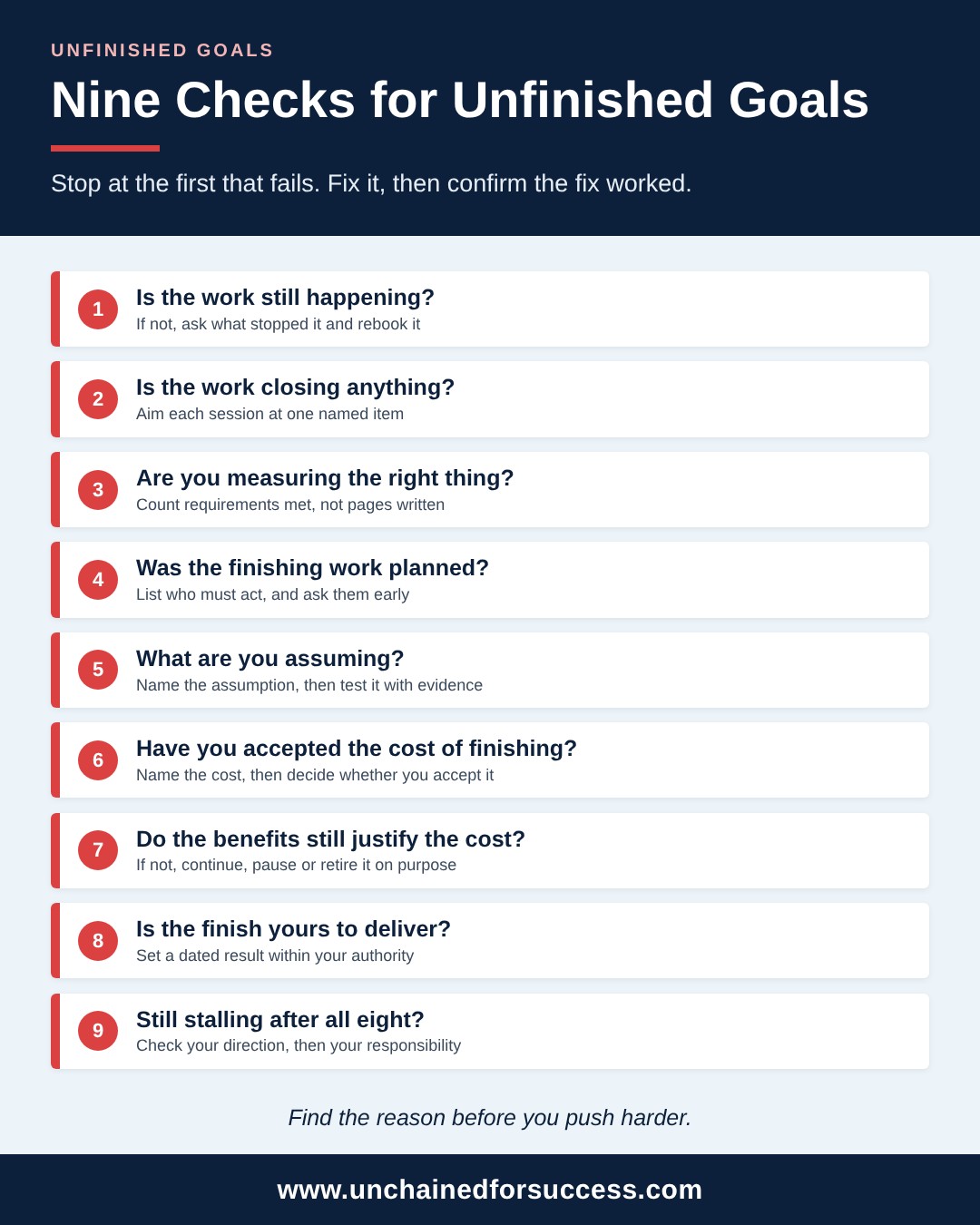
4. Was the Finishing Work Planned?
Sign: the last pieces depend on other people, or on experience you do not yet have, and nobody planned for them. Fix: list everything still to close, including who else must act, and ask them early.
Before you set a date, look at how long a similar sign-off, review or submission actually took last time. Where the experience is missing, plan how you will obtain it, then move the date to when that evidence can exist. Chartership: sponsors never asked; or a senior career that never covered some of the requirements.
5. What Are You Assuming?
Sign: the evidence meets the standard and you still hesitate. Fix: name the assumption, such as "my experience is too narrow to meet the standard", then test it. Ask someone who knows the standard to judge your evidence, or arrange a mock review. Chartership: a sponsor confirms the map is complete, and the candidate still will not submit.
6. Have You Accepted the Cost of Finishing?
Sign: the remaining work is clear, but you avoid it. Fix: name what finishing will cost you, such as the exposure of being judged, a fee, or asking for help. Then decide whether you accept that cost and its consequences, knowing what you know now. Chartership: the review itself is the cost the candidate never agreed to carry.
7. Do the Benefits Still Justify the Cost?
Sign: you are no longer sure the result is worth it. Fix: compare what finishing will give you with what it will cost. If it no longer justifies the effort, decide on purpose. Why People Lose Motivation at the End of the Year shows how to continue, pause or retire a goal. Chartership: the next role no longer asks for it.
8. Is the Finish Yours to Deliver?
Sign: your finish depends on someone else's decision, or nobody ever stated it. Fix: move the finish to a dated result within your authority. "Get chartered" depends on the reviewers.
Where part of the finish needs another person's input, such as a sponsor's statement, set a dated result you can deliver yourself first: your evidence sent to them for review. Once their input is in place, the complete submission by the deadline becomes the next result. A measurable result like that, within your authority and tied to a date, is what the framework calls an Outcome Goal.
9. Does It Still Fit Where You Are Heading?
Normal checking ends at check 8. If the goal keeps stalling after you have worked through the earlier checks, or the breakdown is wider, repeated or part of a formal recovery, ask two further questions, in this order. First, does the goal still fit the direction you have chosen? Then, does it still serve the responsibility you took on?
Fix: if either answer is no, review the goal before you spend more on it. Chartership: a move into a different field has made the qualification irrelevant to where she is heading.
Unfinished Goals in Practice: One Chartership
Take an illustrative case. A civil engineer has been nearly ready for her Chartered Professional Review with the Institution of Civil Engineers for eighteen months. ICE asks for a Professional Review report, a CV, CPD records and evidence of development to the chartered level, with statements of support from sponsors. Two experienced civil engineers then review each candidate.
Most Saturday mornings go on the report, so the first check holds. Each session finishes a section, so the second holds too. She measures progress by the attributes she can demonstrate at the required level, and her map shows evidence against every one, so the third holds.
The fourth check fails. She has never asked her sponsors for their statements of support, because the report never felt ready to show them. She has not chosen a submission window either.
Her statements depend on her sponsors, so she separates what she can deliver from what they decide. Her immediate goal is to send the evidence pack to her sponsors by Monday 4 January. She asks each of them for comments within two weeks and agrees a date for their statements well before ICE's sponsor deadline of 12 March 2027. Once they have submitted their statements of support, she can complete her application by ICE's deadline of 19 March 2027.
Then she checks whether the repair worked. If the sponsors' comments arrive on time, the plan is holding. If a date slips, she goes back to the plan and that dependency, and asks how long a sponsor review actually takes, before she looks any further down the list.
What the Research Says About Finishing Unfinished Goals
Buehler, Griffin and Ross (1994) followed psychology students writing honours theses. For the 33 whose completion times the researchers could analyse, the average prediction was 33.9 days and the average actual time was 55.5 days. The paper reports that 29.7 per cent of respondents finished within their best estimate. In a later study in the same paper, students who first connected relevant past experiences to their forecast lost the optimistic bias for a short course assignment.
These were students, not professionals near the end of a long goal. The practical lesson for the fourth check is this post's reading: people can underestimate the work left on unfinished goals of their own, and looking at how long similar work actually took is a better basis for a date.
Locke and Latham (2002) summarised 35 years of goal-setting research. Specific, difficult goals generally led to higher performance than vague instructions to do your best. They studied performance targets, not finishing. Applying the idea to the third and eighth checks is this post's reading: a specific finish replaces a vague sense of being nearly there.
Common Questions About Unfinished Goals
Do Unfinished Goals Need All Nine Checks?
No. Stop at the first check that fails. Fix what you find, then check whether the fix worked. If that check now passes and the goal is still stalled, move to the next one.
What if I never feel ready?
Then stop waiting for the feeling. Define ready as every requirement evidenced to the standard, test that with someone who knows the standard, and set the date.
What if someone else decides the result?
Your finish is what you can deliver: first anything you hand to others for their input, then the complete submission once that input is in place. That applies to a chartership application, a dissertation or a promotion case. Their decision follows it. Stretch Goals Must Stay Within Your Control: 5 Tests explains why.
Find the Reason Before You Push on Unfinished Goals
Unfinished goals stall near the finish because the work changes: you are judged, you need other people, you close rather than make, and new costs appear. Pushing harder fixes none of those on its own. Check in order, stop at the first check that fails, fix it, and confirm the fix worked before you move on.
Pick one unfinished goal. Start at check 1 and work down until you find the first thing to fix.
To see which part of that goal is weakest, try the Goals Readiness Score. It is 18 questions, about ten minutes, with your results after the contact details step.
Which check would your nearly finished goal fail first?
Further Reading
These ideas draw on the Unchained Goals Framework. For related guidance see Standards Define Outcomes: 5 Tests to Apply This Week and How to Finish the Year Strong Using Gratitude and Growth. ICE submission contents and deadlines are from the ICE pages listed under Sources, read on 20 November 2026.
Sources
• Buehler, R., Griffin, D. and Ross, M. (1994). "Exploring the 'planning fallacy': why people underestimate their task completion times." Journal of Personality and Social Psychology, 67(3), 366-381. Available at: https://doi.org/10.1037/0022-3514.67.3.366.
• Institution of Civil Engineers (2026). "Key membership dates." Available at: https://www.ice.org.uk/join-ice/key-membership-dates.
• Institution of Civil Engineers (2026). "Professional Review." Available at: https://ice.org.uk/membership/my-membership/professional-review/.
• Locke, E. A. and Latham, G. P. (2002). "Building a practically useful theory of goal setting and task motivation: a 35-year odyssey." American Psychologist, 57(9), 705-717. Available at: https://doi.org/10.1037/0003-066X.57.9.705.
Continue Your Journey
Explore more resources from the Unchained Goals Framework: