


The goal that felt urgent in January now sits at the bottom of the list. The evenings are dark and the diary belongs to other people's deadlines. A quiet voice says to pick it up in the new year. If you lose motivation at the end of the year, you are not weak and you are not alone. The tiredness is real. What follows is about the part that rest does not fix.
That part is a date doing a reason's job. In January you wrote "by 31 December" next to the result you wanted. The date has carried the goal ever since. When the calendar runs out, the goal seems to run out with it. Two questions separate the date from the reason.
• What would actually happen if I missed 31 December?
• If I took that date away, would I still want the result enough to do the work, at what the work costs now?
The first tests the deadline. The second tests the reason. Neither answer is "try harder", and together they show why this goal, of all your goals, is the one you lose motivation for as December approaches.
A date can help you plan. It cannot tell you whether the result is still worth the work.
Real Deadlines, Written Dates, and Where You Lose Motivation
Some dates matter because the world will not wait. On a railway, a junction gets rebuilt during the Christmas blockade. That is when the line is closed and the track is yours. The closure was booked years ago and operators and passengers have planned around it. Miss the window and the next one may be a year away.
A date is real when something outside you fixes the cost of missing it, or when other people have built their plans on it.
Other dates matter only because you wrote them down. "By 31 December" on a personal goal may be nothing more than a date you chose in January so the goal would not drift. If you miss it, nothing outside you changes. The cost is the delay, and only you can say what that is worth.
Before you decide which kind you have, look for a window you have not checked. Exams have fixed sittings. Professional bodies have submission windows. Customers set budgets at particular times of year. A real date can hide behind a written one.
One way to lose motivation at the end of the year is to treat a written date like a real one. December then arrives as a verdict.
What It Looks Like When You Lose Motivation Near the Finish
Take an illustrative case. A quantity surveyor is working towards chartered status through the RICS Assessment of Professional Competence (APC). The main pieces she is working on are the summary of experience against her competencies, a case study of up to 3,000 words on a project from the two years before she submits, and her CPD record.
In January she wrote "submission complete by 31 December" so the new year would be free for her counsellor's review and interview preparation.
By 7 November the summary of experience is done except for three technical competencies. The case study has a rough outline and nothing more. The site is busy before the Christmas shutdown, and writing before Christmas would mean two evenings a week she had promised to her family. She has started to say she will "pick it up in January".
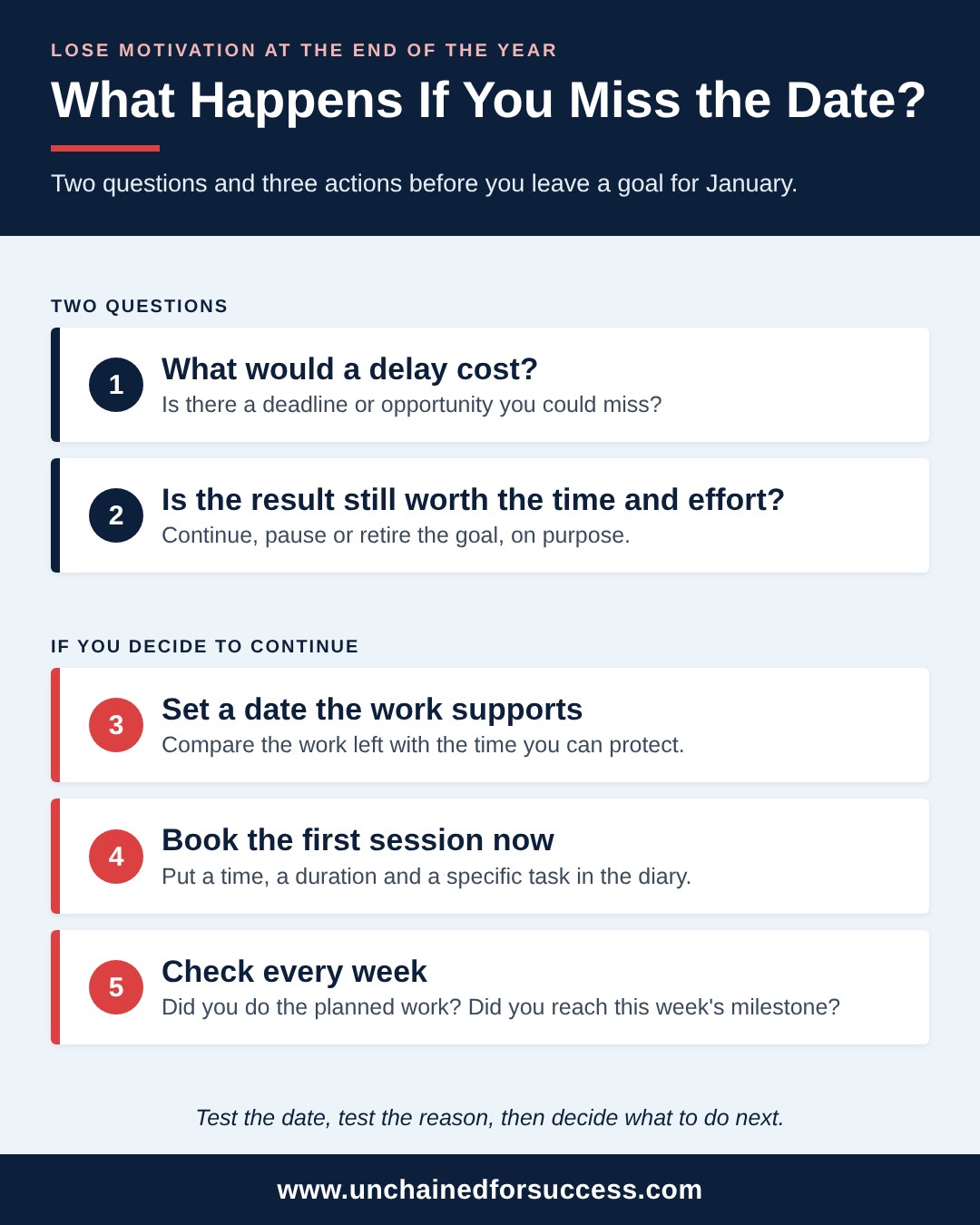
Said that way, it is a drift, not a decision. That is the quietest way to lose motivation: not by deciding to stop, but by never deciding at all. Here is the difference, in five steps you can run in the week you lose motivation.
Step 1: Ask What Would Happen If You Missed the Date
She wrote the answer down. Missing 31 December would still leave her eligible for the spring assessment, but it would use some of the time she had set aside for review. The dates that matter belong to RICS: for her pathway, intent to submit between 9 and 25 February, the submission window from 15 to 25 March, and an assessment period that begins on 10 May.
Two dates would cost her the session: 25 February if she has not declared her intent to submit, and 25 March for the submission itself.
She wants her counsellor to review the whole submission in February, so she aims to have it complete by 30 January. That gives her three dates with three different jobs. 31 December was the target she chose. 30 January is the target she plans around. 25 March is the last one that would cost her the opportunity.
The deadline test is not "when did I say" but "what would I lose by finishing a week or a month later?" If the answer points to a window, that is your real date. If nothing outside you fixes the cost, the month where the delay becomes unacceptable is your date.
Step 2: Ask Whether You Would Still Want the Result Without the Date
Then she took the date away and asked the second question. Did she still want chartered status enough to give the hours, at today's cost? Yes. She wanted it because it would help her pursue roles with more responsibility for advising clients, and that was still worth some Saturday mornings and Tuesday evenings in January. She wrote that down beside the cost.
That written reason, set against the cost, is what the Unchained Goals Framework calls your Why: the part of a goal that decides whether it survives once the cost arrives. January's reason may not cover November's cost; write it against today's.
The answer is not always yes. If the result still matters but the time has gone, set a date to review it. If the result no longer justifies the cost, make a deliberate decision to close the goal. The questions at the end cover both. Either way, answer in writing before you decide anything about the date.
Step 3: Set a Date the Work and the Window Support
Then she counted the work. Three competencies at about four hours each: 12. The case study, 3,000 words with appendices: 16. Tidying the CPD record: 2. Her own read-through and revisions before it goes to her counsellor: 6. That is 36 hours. Then the time she was willing to give:
• Saturday mornings from 14 November to 19 December, 9 am to 12 noon: six sessions, 18 hours. Evenings stay with her family, and the Christmas break is out.
• Tuesday evenings (two hours) and Saturday mornings (three) from 5 to 30 January: four weeks, 20 hours.
That is 38 hours against 36 needed, so the first week of February stays as a reserve.
If your work does not come in pieces like these, make it: named parts, a guessed number of hours for each, and a weekly check that corrects the guess. If you cannot guess, make the first session the one that tells you. The less certain the work, the bigger the reserve.
Her result now has a date the work and the window support: a complete submission, ready for her counsellor, by Saturday 30 January. In the framework's terms that is an Outcome Goal, a dated result within her authority. Whether the assessors pass her in May is their decision, so it cannot be her goal.
Step 4: Book the First Session Now
This is the step that separates a revised plan from "I'll pick it up in January". She put the first Saturday in the diary that evening: 14 November, 9 am to 12 noon, case study project summary and full outline. Every session has a time, a length and a named piece of work, so she never opens the laptop to decide what to do. A booked session is the cheapest insurance against the week you lose motivation.
For some goals the first step is a booking: the exam entry or the course place that secures the date. If that is yours, make the booking the first session.
Step 5: Check Each Week
Each week has a milestone sized to its hours: the first Saturday for the case study's project summary and full outline, the next two for its first draft.
Every Sunday she runs two checks, in this order. Did she do the sessions she planned, and if not, what interrupted them and where does the time get recovered? Only then: did she reach this week's milestone? If the hours went in and the milestone did not arrive, she checks what held up the work before changing the estimate or the plan.
Checking output first and arguing about effort afterwards cannot tell a bad estimate from a bad week; this order can. It is also what stops one bad week becoming the week you lose motivation.
The plan did not run clean. A site call-out took the 5 December session, and the case study took 17 hours, not 16. Her Sunday checks showed the lost session before Christmas and the overrun by mid-January, and that she would be two hours short at the end of January. So the last revisions ran into her reserve, and she finished on Saturday 6 February.
Her counsellor reviewed it that month, she gave her intent to submit, and the submission went in during the March window with days in hand.
Her January date was never the point; the assessment was.
What the Research Says About Fresh Starts and Finishing
Two studies bear on the argument above. Neither tests the five steps. Their samples are dieters, gym members and web searchers rather than professionals on a long project, and how they apply here is this post's reading.
Hennecke and Converse (2017) found that people planning a goal preferred to start just after a boundary, such as a Monday or the first of a month, partly because they paid less attention to the obstacles on the far side. In a field experiment, aspiring dieters were more likely to give up a week of access to an expensive programme if it let them start on such a day.
A boundary makes a later start look easier, and people paid a real price for it. That is why I suggest booking the first session before you say "I'll pick it up in January".
Dai, Milkman and Riis (2014) found in three archival studies that searches for "diet", gym visits and commitment contracts on a goal-setting website rose after temporal landmarks, including the new year. The studies measured whether these activities and commitments rose after a landmark, not whether they were sustained.
Common Questions When You Lose Motivation at the End of the Year
What if I still want the result but the hours have gone?
Then pause on purpose. Decide when you will review the goal or what must change before you restart, ideally both: "after the dissertation is in", "if cash is above the line in March". Tell anyone counting on the result. If a window from Step 1 passes while you are paused, that opportunity is gone, though the wider result may still be worth it.
What if the honest answer is no?
Test the no first: would it still stand once the immediate pressure passes? If it might change, set a date to review it before closing the goal. If it stands, retire the goal on purpose rather than letting it fade. Write why you are stopping, against today's cost, say what you keep, and tell the people affected. A goal that fades is never finished and never ended; that is what comes back as guilt in January.
Is it normal to lose motivation in December?
A dip is no surprise when a date has been carrying the goal on its own. Ask the two questions before you conclude anything about the goal or about yourself.
Isn't moving the date just giving up?
Not if the new date comes from something real and you have booked the first session. Giving up is leaving the date in place, booking nothing, and calling it January. Moving the date is a decision; drifting past it is not.
Five Steps to Take When You Lose Motivation
• Ask what finishing later would cost you, and whether a real deadline sits behind the date.
• Take the date away. Still want the result at today's cost? Continue, pause or retire on purpose.
• Break the work into pieces, count the hours and weeks, and set the date they support.
• Book the first session now, with a time, a length and a task.
• Check weekly: did you do the planned work, and did you reach this week's milestone?
To find out whether the rest of your goal is built to hold up under this kind of pressure, try the Goals Readiness Score. It is 18 questions, about ten minutes, with your results after the contact details step.
Write down the one goal you were about to leave for January, and your answers to the two questions.
What would finishing later cost you, and is the result still worth the work?
Further Reading
These ideas draw on the Unchained Goals Framework. For related guidance see Why Habits Matter More Than Motivation for Success, Recovering Momentum After Disappointment and Why Goals Without Purpose Feel Empty. APC dates and submission contents are from the RICS pages listed under Sources, read on 4 November 2026.
Sources
• Dai, H., Milkman, K. L. and Riis, J. (2014). "The fresh start effect: temporal landmarks motivate aspirational behavior." Management Science, 60(10), 2563-2582. Available at: https://doi.org/10.1287/mnsc.2014.1901.
• Hennecke, M. and Converse, B. A. (2017). "Next week, next month, next year: how perceived temporal boundaries affect initiation expectations." Social Psychological and Personality Science, 8(8), 918-926. Available at: https://doi.org/10.1177/1948550617691099.
• RICS (2026). "Assessment dates - UK." Available at: https://www.rics.org/candidates/assessment-information/assessment-applications/uk (read 4 November 2026).
• RICS (2026). "APC submissions and assessment." Available at: https://www.rics.org/candidates/assessment-information/apc-submissions-assessment (read 4 November 2026).
Continue Your Journey
Explore more resources from the Unchained Goals Framework: