


It is nine on a November evening. The half hour you saved for the application, the assignment or the proposal has finally arrived. You read the same sentence three times. The result still matters, and you still want to finish strong before the year runs out. The question is what to do with the half hour you have.
To finish strong when energy is low, make a decision about the session in front of you instead of hoping the next one goes better. One question does most of the work.
The Question That Helps You Finish Strong
What can I do well with the energy I have right now?
Push on regardless, or go to bed. Those are the two answers usually on offer, and the question above gives you a third. Match the work to the capacity you have tonight, then make that match a decision rather than a drift. Whatever you answer, the evening ends with something written down.
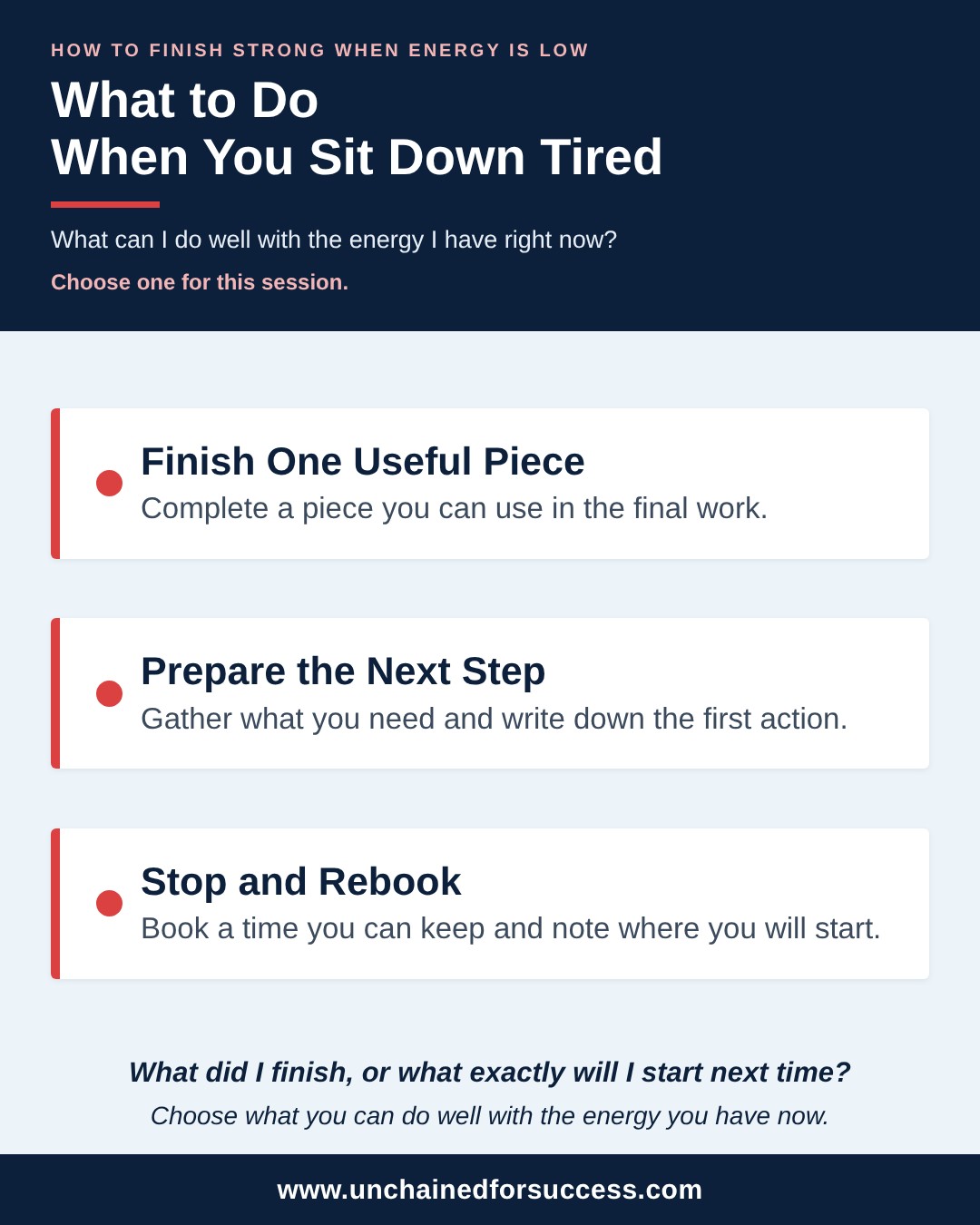
There are three honest answers.
Three Choices That Help You Finish Strong
Finish One Useful Piece
If you can do a smaller piece well, finish it. Choose a piece you can use in the final work, rather than something you will have to start again when you are sharper.
Prepare the Next Step
If you cannot write well but you can still think, prepare. Gather what the next session needs, decide which material you will use, and write down the first action for next time.
Stop and Rebook
If you can do neither well, stop. Book a time you can keep, write down where you will start, and close the laptop. A session you end on purpose costs you the half hour. One you spend rereading costs the same half hour and takes your confidence with it.
Before you put the work away, answer one more question.
What did I finish, or what exactly will I start next time?
One Application, Three Ways to Finish Strong
Take an illustrative case. An engineer wants to apply for a project manager vacancy that closes on Friday 4 December. The form asks for two written examples showing how she meets the criteria, and a covering statement.
She commits to one result: a complete application, submitted by Thursday 3 December. The employer decides whether to offer her the role, so that cannot be her goal. A dated result she has the authority to deliver is what the Unchained Goals Framework calls an Outcome Goal.
She set the plan on Saturday 14 November. That morning she drafted the opening of the first example and listed the evidence it still needs. Tuesday 17 November was for finishing that example. At nine o'clock she sits down and can tell she will not get through all of it well tonight. Here is what each of the three choices looks like on that evening.
· Finish one useful piece. She writes the one section she can still do properly, the part that sets out the problem she found on site. It runs to 150 words and goes into the form.
· Prepare the next step. She gathers the evidence for that same example and finds the email that records the outcome. Then she writes one line at the top of the page: start by describing what you changed.
· Stop and rebook. She closes the form, moves the forty-five minutes into Saturday morning, and still writes that one line, so Saturday opens with writing rather than deciding.
The three are alternatives for the same evening, and any of them uses it well. The fourth option, reading the criteria again until half past nine, is the only one that produces nothing. She took the first.
Count the Work Still to Do
Three good choices will not rescue a plan that assumes more time than the weeks contain. Counting the work takes ten minutes and tells you whether the date still holds. If no outside date fixes yours, set one from what a month of delay would cost, then count against that.
She listed the work still to do. First example, three hours. Second example, three hours. Covering statement, two hours. Read through and submit, one hour. Nine hours in total.
Then the time she was willing to give:
· Saturday mornings, 9 to 11, on 14, 21 and 28 November: six hours.
· Tuesday and Thursday evenings, forty-five minutes each, from 17 November to 3 December: six sessions, four and a half hours.
Ten and a half hours against nine. The final Tuesday and Thursday stay empty as a reserve, so the work finishes on Saturday 28 November if nothing goes wrong, and by Thursday 3 December if something does.
If your work does not arrive in named pieces like these, name them anyway and guess the hours. The weekly check will correct the guess, and the less certain the work, the larger the reserve should be. Every session then gets a time, a length and a named task, so you never open the laptop to decide what to do.
A tired hour used well still moves the work. The same hour spent deciding what to do moves nothing.
A Weekly Check That Helps You Finish Strong
Once a week, in this order:
1. Did the planned sessions happen, at the length I planned?
2. Did they produce the work I expected?
Those two questions tell you different things, and the order matters. If the sessions happened and the work did not arrive, look at the way you worked before the hours you allowed, and at both before your effort. If the sessions did not happen, ask what interrupted them and where the time comes back, before you touch anything else. Asking about output first and effort afterwards cannot tell a bad estimate from a bad week.
That is a simple version of what the Unchained Goals Framework calls a Control System. The full one compares results against a standard you agreed in advance and sets the point at which you stop and look harder. Two questions once a week is enough for a goal this size.
The plan did not run clean. A late finish at work cost her the Thursday of the second week. The covering statement then ran forty-five minutes over the two hours she had allowed. The weekly check caught each of them in the week it happened. Together they used the whole reserve, and the application went in on Thursday 3 December with nothing to spare.
When the Same Task Keeps Getting Moved
What matters is the consequence, not the count. One missed session is enough to act on if it puts the date at risk, and several are tolerable if they do not. Decide in advance what would send you back to the plan, and write it down while the work is still going well. For weekly work, two moved sessions in a fortnight is the point I would suggest looking. Any slip that threatens the date brings that forward.
When you reach your number, examine the time and the energy the plan assumes rather than your discipline. Move the demanding work to a part of the week you can actually use, and take something off the list to make room for it.
If the remaining work no longer fits before the date, decide early what changes: the scope, the date, or both. Where other people are relying on you, tell them while they can still act on it. Changing the plan on evidence is part of how you finish strong, not an admission of failure.
For help finding a better part of the week, see Energy Management Beats Time Management. If the date itself is the question, see Why People Lose Motivation at the End of the Year.
What the Research Says About Plans and Restarts
Two studies bear on the advice above. Neither tested it.
Gollwitzer and Sheeran (2006) reviewed 94 tests of a simple idea: deciding in advance when, where and how you will act. Across those tests, people who made that kind of plan were more likely to follow through than people who held the same intention without one.
That is the case for booking a session with a time, a length and a task, rather than promising yourself you will get to it. In the evening above it looks like this. If I cannot draft the example tonight, I will open the project email at 9 am on Saturday.
Leroy and Glomb (2018) studied interruptions at work. Writing a brief note about where to pick the work up again helped people give their attention to whatever they turned to next.
They worked with professionals in a survey and small groups in a laboratory. They measured the task people moved on to, not the return to the work they had left. Using that note to make tomorrow's restart easier is my application of the idea rather than their finding.
Common Questions About How to Finish Strong
Would I be better off just resting?
Sometimes, and the third choice is how you rest without losing the thread. Stopping with a booked time and a written first action costs you one session. Stopping with neither is what turns one tired evening into a fortnight away from the work.
What if every evening is a low-energy evening?
Then the evenings are the wrong place for this work, and no amount of choosing well inside them will fix that. Look for a part of the week that is genuinely usable, early mornings or a weekend block, and move the demanding work there. If nothing in the week can hold it, the plan needs changing rather than the effort.
Is stopping early the same as giving up?
Not if you stop with a booked time and a written first action. That is a decision about tonight. Giving up is closing the laptop with neither, and telling yourself you will pick it up in January.
Finish Strong This Week, Not in January
To finish strong from here, ask what you can do well with the energy you have. Finish a piece, prepare the next step, or stop and rebook. Count the work against the weeks that remain, so you know whether the date still holds. Then check each week whether the sessions happened and whether they produced what you expected.
Write down the one piece of work you want to finish before the year ends. Then write the time, the length and the task of your next session.
To check whether the rest of that goal will hold up under this kind of pressure, try the Goals Readiness Score. It is 18 questions, about ten minutes, with your results after the contact details step.
What can you do well with the energy you have tonight?
Further Reading
These ideas draw on the Unchained Goals Framework. For related guidance see How to Finish the Year Strong Using Gratitude and Growth, Process Goals: How to Turn Effort Into Results and Why Habits Matter More Than Motivation for Success.
Sources
· Gollwitzer, P. M. and Sheeran, P. (2006). "Implementation intentions and goal achievement: a meta-analysis of effects and processes." Advances in Experimental Social Psychology, 38, 69-119. Available at: https://doi.org/10.1016/S0065-2601(06)38002-1.
· Leroy, S. and Glomb, T. M. (2018). "Tasks interrupted: how anticipating time pressure on resumption of an interrupted task causes attention residue and low performance on interrupting tasks and how a ready-to-resume plan mitigates the effects." Organization Science, 29(3), 380-397. Available at: https://doi.org/10.1287/orsc.2017.1184.
Continue Your Journey
Explore more resources from the Unchained Goals Framework: