


The goal is clear. You wrote the plan. Somehow the important thing keeps sliding to next week, and the reason you give yourself each time sounds completely fair. That is the tell. Beliefs that undermine your goals almost never arrive as doubt. They arrive as good judgement.
This post sets out how to find the one that is costing you. It also covers why arguing with it does not work, and how to test it instead. It follows Why Identity Limits Performance and Growth, which covers the ceiling these beliefs create.
Why Beliefs That Undermine Sound So Sensible
"Now is not the right moment." "I need a bit more experience first." "That kind of work goes to bigger firms."
Notice what those have in common. None of them is despairing. Each one could be true. Each one would pass without comment in a meeting. Beliefs that undermine your goals are camouflaged, and this is the camouflage.
That is exactly why they work. A thought that announced itself as fear would invite an argument. A thought that presents as prudence tends to get through unexamined.
So the belief that costs you is not necessarily the loud one. It may be the reasonable one you have stopped examining.
What a Hidden Belief Actually Is
A belief, for this purpose, is a claim you have stopped testing.
That is a useful definition because it tells you where to look. Not for negativity, but for claims about yourself or your situation that you treat as settled facts. "I am not a morning person." "Our clients will not pay that." "I am bad at networking."
Some of those will turn out to be accurate. That is fine. The problem is not being wrong. Beliefs that undermine your progress do their damage by going unchecked, and a claim nobody checks can carry on shaping decisions long after it stopped being true.
How Beliefs That Undermine Keep Themselves Alive
There is a well-reviewed reason for this, and it is not mysterious.
People seek and interpret evidence in ways that favour the belief they already hold. Nickerson's review of this literature puts it plainly (Nickerson, 1998). We are more likely to question information that conflicts with what we believe than information that agrees with it, and more likely to read ambiguous information as confirming.
Apply that to "I am bad at networking". You remember the event you left early. A conversation that led to work goes down as luck. The invitation you declined never gets weighed against it, because you were not looking for a counterexample.
The belief is not merely sitting there. It is quietly editing the evidence. A belief that edits the evidence is not tested by experience alone, however much of it accumulates.
Where They Come From, and Why That Matters Less Than You Think
The origins are usually ordinary. Someone said it often enough to feel true. Or an early attempt went badly. Or a role you took at twenty-two turned into a description of who you are.
It is worth knowing the origin, because it explains why the belief feels like fact rather than opinion. It is not worth dwelling on, because knowing where a belief came from is not the same as having anything new to weigh against it.
Some of these were protective once. Avoiding visibility, avoiding rejection, avoiding a price conversation all felt safer at some point. What protected you then can limit you now, and neither fact makes the belief true today.
How to Find the Beliefs That Undermine Your Goals
Hesitation is a practical place to look, because it is the moment just before you avoid something.
Four questions locate them. Ask them while the hesitation is happening, or as soon after as you can manage.
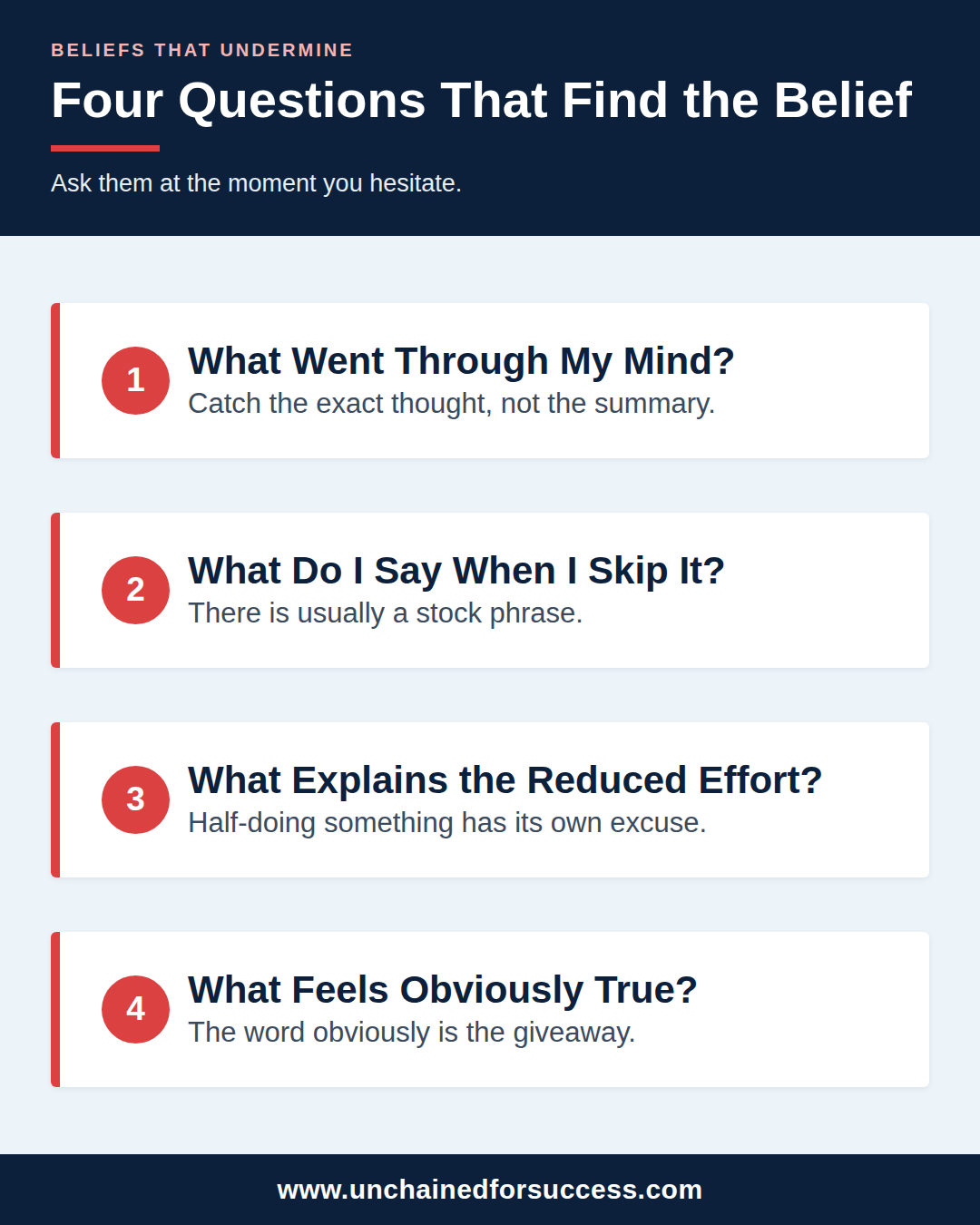
What went through my mind just before I put that off? Catch the exact thought, not the summary.
What do I say when I decide to skip it? There is usually a stock phrase.
What explains the reduced effort? Half-doing something has its own excuse.
What feels obviously true about why this will not work for me? The word "obviously" is the giveaway.
Those four questions are how you catch beliefs that undermine your goals in the act. Write the answers in your own words, not tidied up. "I do not have the bandwidth this quarter" is the polished version. The unpolished version tends to be shorter and more personal, so keep writing until it sounds like you.
Separate the Fact From the Interpretation
This step does not change the belief. It makes the belief testable.
"I missed the deadline" is a fact. "I am unreliable" is an interpretation laid over it. "Two clients said no" is a fact. "My pricing is wrong" is an interpretation, and so is "I am not good enough for that market".
Write the fact on one line and the interpretation underneath. Separated out, the interpretation stops looking like the event and starts looking like a claim about you, which is something you can put a test to. Beliefs that undermine your goals usually sit in the interpretation placed over the fact, rather than in the fact alone. Facts can be incomplete or wrongly measured too, which is worth remembering when the test comes back.
What Happens When You Argue With Beliefs That Undermine
The standard advice at this point is to replace the negative sentence with a positive one. It is worth knowing how that has performed under testing.
The nearest large-scale test is growth mindset teaching. That is an adjacent idea rather than the same one, because it changes what students believe about their ability rather than the sentence you repeat to yourself. The companion post on identity goes through that evidence in detail. The short version is that when researchers pooled 63 studies, the average effect on results did not survive a correction for publication bias (Macnamara and Burgoyne, 2023).
Why should that be? Arguing with a claim rarely removes it, because the argument is just another claim. The same tendency to question what conflicts with what you believe applies to the new sentence as readily as to the old one.
What does shift a belief is evidence it struggles to explain away. The research gives little support to changing results through belief statements alone, and it does not by itself prove that small tests are the answer. That second step is the practical conclusion drawn here: generate evidence under manageable risk, then look at what the result actually supports.
Turn the Belief Into a Claim You Can Test
Written down, the claim is back in the open. What makes it live again in practice is that you start testing it, and that changes what you do next.
Take "our clients will not pay more". As an untested belief it governs your pricing indefinitely. As a live claim it is answerable: quote the higher price to the next four enquiries and see what happens.
The test has to be small enough to actually run, and specific enough that the result is unambiguous. Four steps turn beliefs that undermine your goals into something answerable.
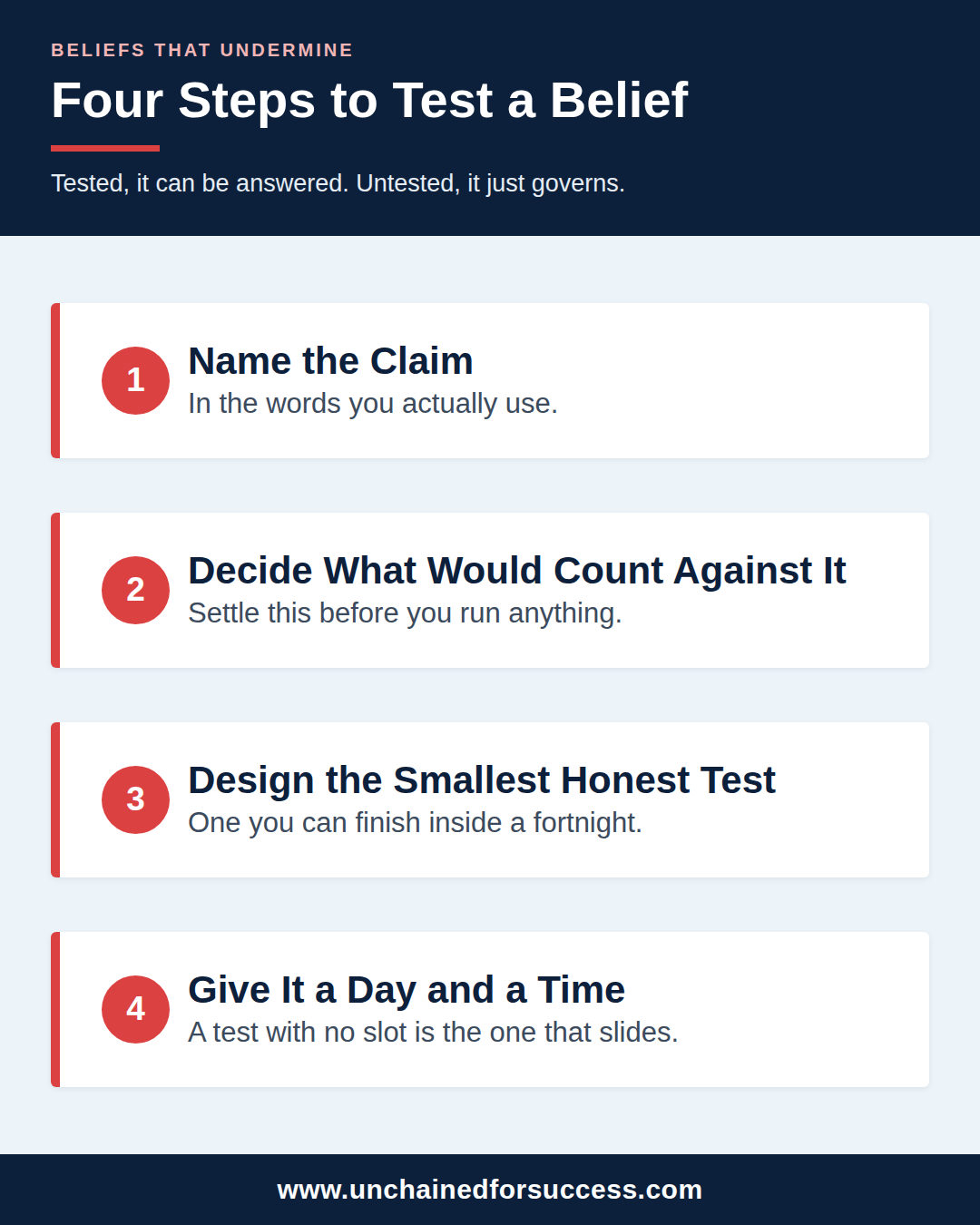
Name the claim in the words you actually use, not the tidied version.
Decide what would count against it, and do that before you run anything.
Design the smallest honest test, one you can finish inside a fortnight.
Give it a day and a time, because a test with no slot is the one most likely to slide.
Why the Slot Matters
That last point has some evidence behind it, from an unrelated setting. In a randomised trial, 3,272 employees were offered a free workplace flu jab (Milkman and colleagues, 2011).
A prompt to write down a date lifted uptake from a control rate of 33.1 per cent by 1.5 percentage points, too small to separate from chance. A prompt to write down a date and a time lifted it by 4.2 points, and that difference did hold up.
That trial tested a vaccination rather than a self-set test. Read it as a reason to give your test a slot, rather than as proof that a slot makes it happen.
Beliefs That Undermine Organisations and Teams
Beliefs that undermine a team run on the same machinery, and at that scale they get expensive. Both examples below are composites rather than clients, with the details invented to make the pattern visible.
A Business Owner Who Would Not Raise Prices
A consultant had held the same day rate for four years. The belief was "my clients will not pay more", supported by one bruising conversation in 2022.
The test was deliberately small. Quote the new rate to the next four enquiries, decline nothing on price, and record the outcomes. Two accepted, one negotiated to a figure still above the old rate, one went elsewhere.
Note what the test does not cover. These were new enquiries, so the result says nothing yet about the clients already on the old rate.
Three of the four paid more than the old rate, though only two paid the new one in full. That did not prove the belief false in general. It was enough to make holding the old rate a decision rather than a default. Beliefs that undermine a business rarely collapse all at once. They lose their authority one result at a time.
A Team That Believed Reporting Bad News Was Punished
A delivery team shared one belief: raising a risk early would count against you. Nobody had ever said so. It shaped what people did anyway.
The consequence was predictable. Risks appeared in reports once they had become issues, which is the point at which they cost the most to fix.
Leadership could not run this test alone, because a risk raised to order is not the act the team is afraid of. What they could do was change the conditions. Name three live risks they wanted on the table within a fortnight, ask for them by name from whoever held them, then say publicly, in the same forum, what happened next to those people.
In the weeks that followed, nothing visible happened to them, and saying so in public was the part that mattered. It is a first result rather than a verdict, which is why the same thing has to happen the next three times too.
Note what actually changed there. Not what anyone believed, but what the team could see was normal, which is the lever the identity post argues is the strongest one.
What to Do When the Test Says the Belief Was Right
Sometimes the answer comes back and the belief holds. The clients really will not pay that. The market really does prefer the larger firm.
That is a good outcome, not a failure. Beliefs that undermine your goals are worth testing even when they turn out to be right, because you now have a constraint rather than a suspicion, and you can plan around a constraint. Change the offer, change the market, change the sequence, or accept it and redirect the effort.
An untested belief is dangerous because nothing has been put to it, not because it is pessimistic. The Unchained Goals Framework treats Beliefs as part of the structure of a goal, alongside the plan and the measures, rather than as a question of attitude. That is why the response here is a test and not a pep talk.
Frequently Asked Questions About Beliefs That Undermine Your Goals
How do I tell a limiting belief from a sensible assessment?
You often cannot, from the inside, which is why beliefs that undermine your goals go unnoticed for so long. That is the argument for testing after reflection rather than for reflection alone. Reflection surfaces the claim; the test settles it. A sensible assessment should survive a small test, and if it does you have lost nothing but a fortnight.
What if I cannot design a test?
Make it smaller. If you cannot test "I am bad at networking", test "I can have one useful conversation at Thursday's event", which is answerable by Friday.
Does this work for beliefs about other people?
Yes, and the team example above is one. "They will not support this" is a claim, and asking three of them is a cheaper test than a year of assuming.
Test the Beliefs That Undermine Your Goals, and Let the Result Stand
Thinking harder is unlikely to settle it, and it does not have to. Beliefs that undermine your goals are not arguments to win.
Catch yourself at the next hesitation and write down the sentence in your own words, with the fact on one line and the interpretation underneath. Then run the four steps: name the claim, decide what would count against it, design the smallest honest test, and give it a day and a time.
You now have one sentence written down, one thing that would count against it, and a slot in the diary. That is the audit.
Then let the result stand, whichever way it goes. Beliefs that undermine your goals depend on nobody checking them. One small test is where the checking starts.
Sources
• Nickerson, R. S. (1998). Confirmation bias: A ubiquitous phenomenon in many guises. Review of General Psychology, 2(2), 175 to 220. https://doi.org/10.1037/1089-2680.2.2.175
• Macnamara, B. N. and Burgoyne, A. P. (2023). Do growth mindset interventions impact students' academic achievement? A systematic review and meta-analysis with recommendations for best practices. Psychological Bulletin, 149(3 to 4), 133 to 173. https://doi.org/10.1037/bul0000352
• Milkman, K. L., Beshears, J., Choi, J. J., Laibson, D. and Madrian, B. C. (2011). Using implementation intentions prompts to enhance influenza vaccination rates. Proceedings of the National Academy of Sciences, 108(26), 10415 to 10420. https://doi.org/10.1073/pnas.1103170108
Continue Your Journey
Explore more resources from the Unchained Goals Framework: