


You wrote it down. You were specific about it, you gave it a date, and you meant it. Three weeks on, nothing much has happened, and nothing obvious went wrong. This is the ordinary way clear goals fail, and the reason has very little to do with how badly you wanted the result.
The usual explanation is discipline, and it is the same mistake that makes being busy feel like progress. That explanation is comfortable, and it sends you looking in the wrong place. What follows is what the evidence actually shows about the gap between deciding and doing, and the four changes that close it, set out as four steps at the end.
Why Clear Goals Stall in the First Three Weeks
Clear goals and action are two different problems. Knowing what you want tells you nothing about what happens at 8.15 on a Tuesday morning when the day has already started badly.
Clear goals live in your head as sentences. Your week, though, runs on moments where something either happens or it does not. Nothing in a well-written sentence decides those moments for you.
So the gap is not a gap in wanting. It is a gap in design, and clear goals fall into it at the point where a result has to become a behaviour.
The Announcement That Quietly Lets You Off
Here is a finding that runs against instinct. Telling other people about your intention can make you less likely to act on it.
Researchers ran four experiments on this (Gollwitzer, Sheeran, Michalski and Seifert, 2009). When people announced an intention that mattered to their sense of who they are, and someone took notice, they did less towards it in what followed. The recognition appears to stand in for the progress. These were controlled experiments rather than studies of people pursuing goals over months, so treat it as a caution rather than a settled law.
That is worth sitting with, because announcing a clear goal feels like the natural first move. It feels like commitment. It can function as a small, early reward for a job you have not yet started.
None of this means keep everything secret. It means the telling is not the doing, and the feeling the telling produces is easily mistaken for momentum.
What Closes the Gap Between Deciding and Doing
One of the best-evidenced fixes for clear goals that will not move is unglamorous. Decide in advance when, where and how you will act.
Researchers pooled 94 independent tests of this and found a solid effect on follow-through (Gollwitzer and Sheeran, 2006). The authors describe the effect as medium to large, and it showed up across very different settings.
The mechanism is not mysterious. "I will write the report" leaves every decision to a future version of you who is tired. "I will write for forty minutes at 8.00 on Tuesday and Thursday, at the kitchen table" has already made them.
Notice what changed. The goal did not get smaller. It got a time, a place and a first move.
Why Clear Goals Need a Cue You Cannot Miss
A cue is anything that reliably comes before the behaviour. A time works. So does a place, a preceding event, or a condition you can recognise.
A study of habit formation in everyday life used "after breakfast" for exactly this reason (Lally, van Jaarsveld, Potts and Wardle, 2010). Breakfast happens whether or not you feel like it, which makes it a better anchor than an intention to start at some point.
Choose the cue before you choose the effort. A clear goal attached to something that already happens has more holding it up than an ambitious one attached to nothing in particular.
How Long Repetition Actually Takes
You have probably heard that a habit takes 21 days, or 66. Both numbers deserve better handling than they usually get.
The 66 figure comes from the study above, and it is a median rather than a rule. Across the 39 of 96 participants whose curves fitted the model well, the time to reach near-automatic performance ranged from 18 days to 254. That is a very wide spread, and it is the honest number.
One further finding from the same study matters more than the headline. Missing a single opportunity did not materially affect the process. A broken day is not a broken pattern.
This is the stretch where abandoning a clear goal becomes tempting. Progress feels slower than expected, you conclude the behaviour is not working, and it stops at a point where it might well have settled. The range is wide enough that nobody can tell you in advance.
The Part Identity Plays, and the Part It Does Not
It is popular to say that lasting change comes from becoming the kind of person who does the thing. There is something in this, and it is narrower than the slogan.
A twelve-week study followed 98 people across three different behaviours (Alfrey, Condie and Rebar, 2025). Identity did predict what people did. But within a given person, the relationship faded once the researchers accounted for intention.
Read plainly, that suggests identity works through your intentions rather than around them. Seeing yourself as a runner helps because it shapes what you intend on a wet morning. It does not replace the intention, and it does not do the running.
That fits what the evidence says about how far identity can carry performance. So treat identity as something that makes the intention easier to form. For clear goals, it is not a substitute for deciding when you will act.
Turning Clear Goals Into Something You Can Do on Tuesday
Everything above points the same way. Clear goals have to travel, step by step, from a result you want down to something small enough to actually happen.
The Unchained Goals Framework does this with a fixed chain, and it is worth naming now that you have seen why each part exists.
The result. What must be true, by when, and yours to deliver. This is the Outcome Goal, and it is not the problem. Naming a result is right. Stopping there is the fault.
The standard. A level you could meet or miss inside the current cycle, which moves before the result does. Standards define outcomes, and this is where the standard lives. The framework calls this a Performance Goal, and its job is to tell you early whether you are on track.
The behaviour. What you will actually do, with its cue and its cadence. This is a Process Goal. It must sit within what you can execute, and it must serve the standard above it.
The routine. That same behaviour once repetition has reduced how much deciding it takes.
The behaviour does not replace the result. It makes the result reachable.
A Worked Example
Take a consultant building a six-module online course, to launch by 30 November.
The result is the six-module course built and launched by 30 November. Note that the date is a condition on the result rather than the result itself.
Beneath it sits a standard: one module completed every fortnight, each scoring at least four out of five against her own quality checklist. The behaviour underneath that is a forty-five minute development session at 9.00 am every Monday, Wednesday and Friday. Her routine, once it settles, is starting that session when the reminder appears, without renegotiating whether today is a good day.
Note where the numbers sit. "One module a fortnight" is a standard, because it is the thing she measures. "Forty-five minutes on Monday, Wednesday and Friday" is still a behaviour, because the number describes what she does rather than the target she is judged against.
She is an illustration, not a client.
What to Do This Week With Your Clear Goals
Take one of your own clear goals that you have carried for weeks without moving. Then work down rather than up.
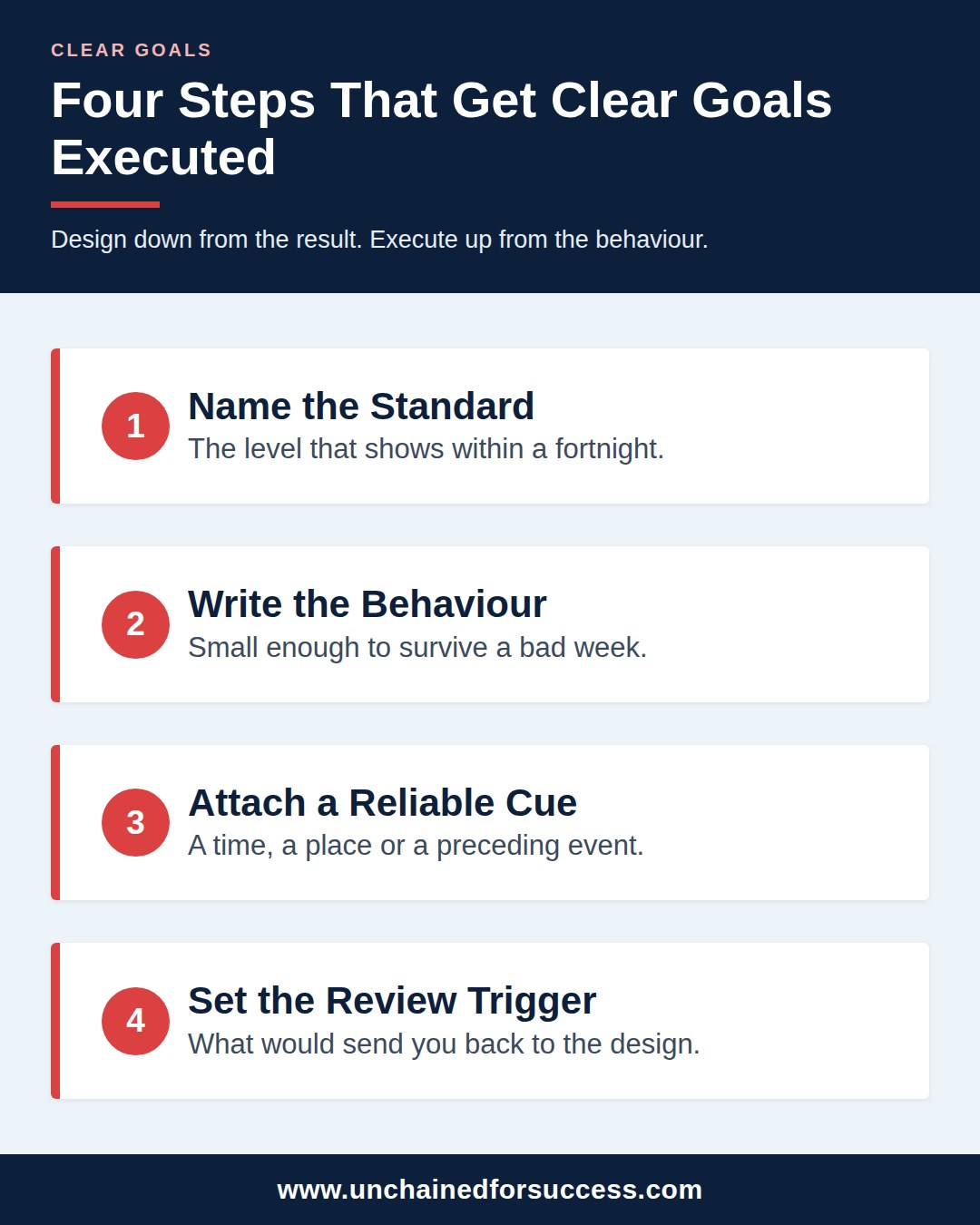
1. Name the standard that would tell you, within a fortnight, whether the result is moving.
2. Write the first behaviour that would produce that standard, small enough that a bad week would not stop it.
3. Attach the behaviour to something that already happens reliably, whether that is a time, a place or a preceding event.
4. Decide now what result at your next review would make you look again at the design rather than at your willpower.
If the first attempt breaks down, there is a method for handling the setback without losing direction. Then expect the middle to be slower than you want. That expectation is the difference between a pattern that settles and one that gets abandoned at week three.
Frequently Asked Questions
Should I stop telling people about my clear goals? Not necessarily. The research concerns announcing an identity-relevant intention to someone who acknowledges it, and then feeling further along than you are. Telling someone who will ask you about the work next week is a different act with a different effect.
How do I know whether the behaviour or the goal is wrong? Check in order, starting with the easiest thing to verify. Did the behaviour actually happen at the agreed cadence? If it did, is it producing the standard? If the standard is being met and the result still is not moving, the standard is measuring the wrong thing. Do not start by redefining the goal.
Are clear goals worth restarting after a missed week? Yes, and the research is unusually encouraging here. A single missed opportunity did not materially affect habit formation in the study above. The damage comes from treating one gap as evidence the whole thing has failed.
Share the goal you have carried without moving, and the first behaviour you will attach to it, in the comments.
If you want an outside view of how your goals are designed, executed and governed, the Goals Readiness Score scores each of the nine components separately and shows you which one is weakest.
What would have to happen this week for the goal to move at all?
Sources for This Article on Clear Goals
- Gollwitzer, P. M., Sheeran, P., Michalski, V., and Seifert, A. E. (2009). When intentions go public: does social reality widen the intention-behavior gap? Psychological Science, 20(5), 612 to 618. https://doi.org/10.1111/j.1467-9280.2009.02336.x
- Gollwitzer, P. M., and Sheeran, P. (2006). Implementation intentions and goal achievement: a meta-analysis of effects and processes. Advances in Experimental Social Psychology, 38, 69 to 119. https://doi.org/10.1016/S0065-2601%2806%2938002-1
- Lally, P., van Jaarsveld, C. H. M., Potts, H. W. W., and Wardle, J. (2010). How are habits formed: modelling habit formation in the real world. European Journal of Social Psychology, 40(6), 998 to 1009. https://doi.org/10.1002/ejsp.674
- Alfrey, K.-L. R., Condie, M., and Rebar, A. L. (2025). The influence of identity within-person and between behaviours: a 12-week repeated measures study. Behavioral Sciences, 15(5), 623. https://doi.org/10.3390/bs15050623
Continue Your Journey
Explore more resources from the Unchained Goals Framework: